Andrew Wyeth
- 1917 – 2009
- American
- Realism, Regionalism
A brief story
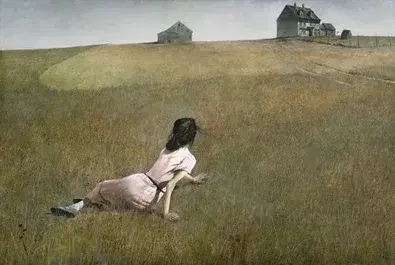
Andrew Newell Wyeth was born in Chadds Ford, Pennsylvania, in 1917, the youngest child of the illustrator N. C. Wyeth, who was his only teacher. He was educated at home due to frail health and developed an intense, solitary relationship with the landscapes and people of two places: the Brandywine Valley of Pennsylvania and the coast of Maine around Cushing, where his family summered. These two locations, rendered with painstaking realism in egg tempera and watercolor, would provide virtually all the subject matter of his long career.\n\nWyeth achieved popular celebrity almost overnight with Christina's World (1948), an egg tempera painting of a woman with crippled legs pulling herself across a dry field toward a distant farmhouse. The image became one of the most reproduced works in American art history. His mature work is characterized by muted earth tones, dry grasses, weathered wood, and figures placed in vast, unsentimentalized landscapes — a vision of rural America at once elegiac and unsettling. He worked slowly and obsessively, sometimes spending years on a single composition.\n\nWyeth occupied a paradoxical position in American art: adored by the general public and major museums, he was often dismissed by the critical establishment as sentimental or retrograde. The 1986 revelation of the Helga pictures — 247 secret works made over fifteen years depicting his neighbor Helga Testorf — provoked a public sensation and reassessment of his range and emotional depth. He died in Chadds Ford in 2009, the most beloved and most contested realist painter of his generation.
Did you know?
America's most beloved and most debated realist, who spent a lifetime painting the spare landscapes of Pennsylvania and Maine with a melancholy precision all his own.
Don’t stop here
More to explore by Andrew Wyeth