Caspar David Friedrich
- 1774 – 1840
- German
- Romanticism
A brief story
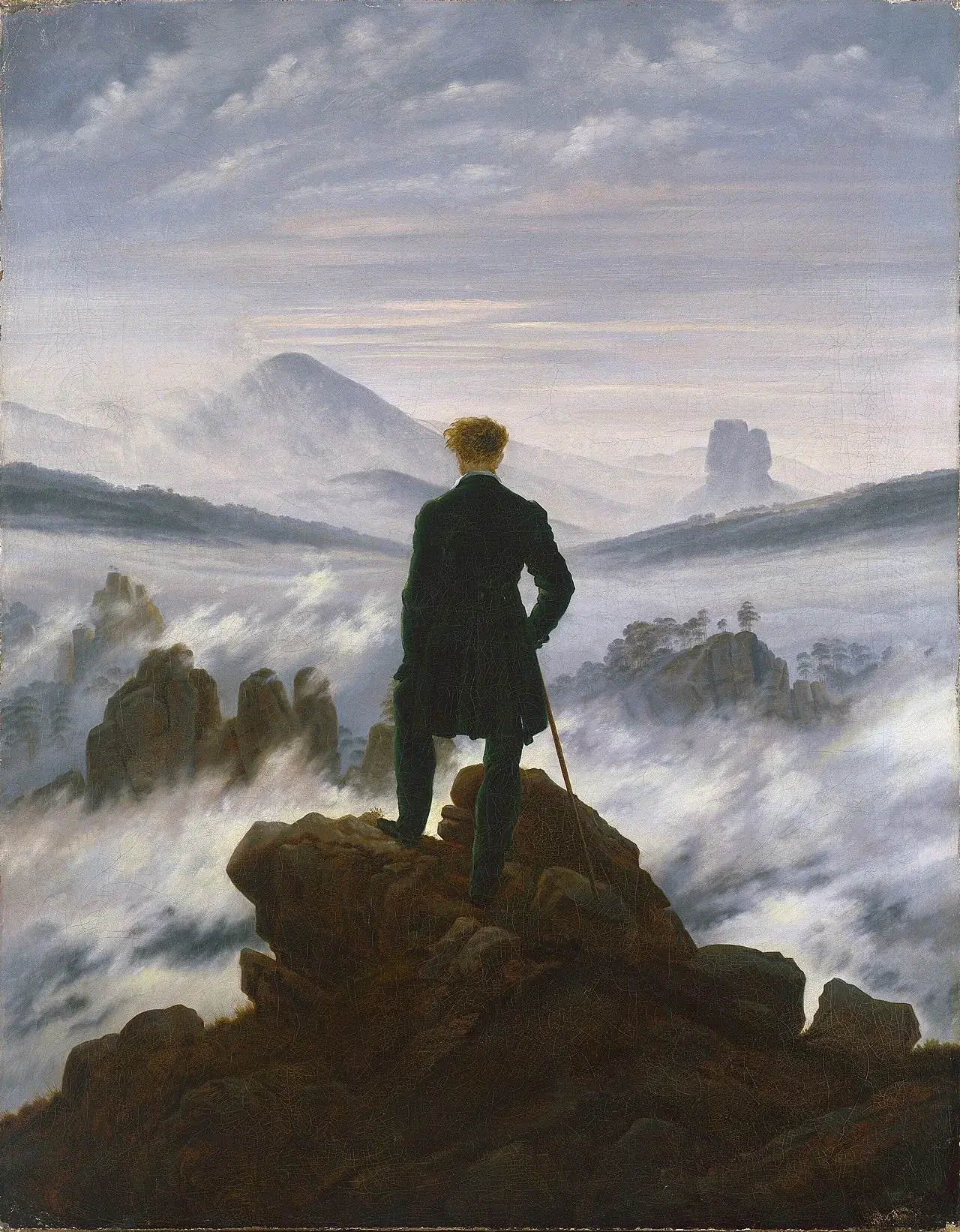
Caspar David Friedrich was born in 1774 in Greifswald, a small port town on the Baltic coast then belonging to Swedish Pomerania. He studied at the Copenhagen Academy of Fine Arts before settling in Dresden in 1798, the city that would remain his home for the rest of his life. Early exposure to the austere Protestant landscape of the Baltic coast and the death of several family members in his childhood deeply informed the melancholy spirituality that pervades his mature work.\n\nFriedrich single-handedly defined German Romantic landscape painting. His canvases replace heroic narrative or mythological subject matter with contemplative solitude: lone figures — the famous Rückenfigur, seen from behind — stand before vast mountain ranges, foggy valleys, storm-battered coasts, or moonlit forests. These figures do not master nature; they are absorbed by it, inviting the viewer to complete the spiritual journey vicariously. Works such as Wanderer above the Sea of Fog (c.1818), The Sea of Ice (1823–24), and Monk by the Sea (1808–10) deploy extraordinary tonal control to translate Lutheran ideas about the divine presence in nature into purely visual terms.\n\nFriedrich fell from fashion after a stroke in 1835 left him partially paralyzed, and he died in relative obscurity in Dresden in 1840. His rediscovery in the early twentieth century — by Symbolists, Expressionists, and later Surrealists — revealed him as a painter of startling modernity whose images of existential solitude in an indifferent cosmos have only grown more resonant with time.
Did you know?
Germany's supreme Romantic landscapist, whose solitary figures standing before misty mountains and stormy seas transformed nature into a mirror of the human soul.
Don’t stop here
More to explore by Caspar David Friedrich