Frederic Leighton
- 1830 – 1896
- British
- Neoclassicism, Pre-Raphaelite
A brief story
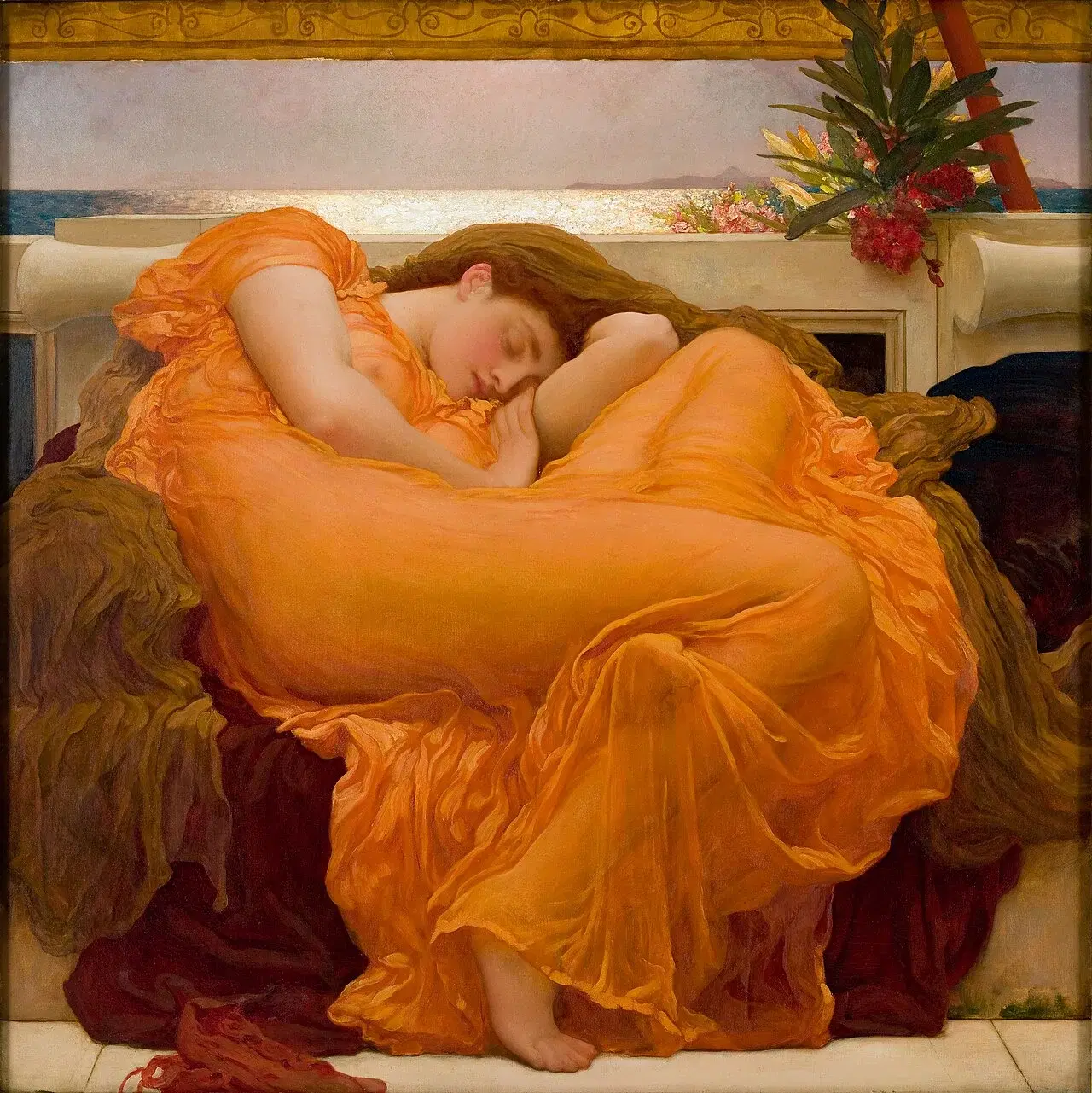
Frederic Leighton was born on December 3, 1830, in Scarborough, England, into a cultivated professional family that encouraged his artistic ambitions from an early age. He trained extensively across Europe — in Frankfurt, Florence, Rome, and Paris — absorbing the traditions of Italian Renaissance masters and the French academic style. His breakthrough came in 1855 when Queen Victoria purchased his painting Cimabue's Celebrated Madonna, exhibited at the Royal Academy; the acquisition made him famous overnight at the age of just twenty-four.\n\nLeighton's mature work is characterised by large-scale paintings of classical and biblical subjects rendered with meticulous draughtsmanship and a sensuously warm palette. He was fascinated by the human figure in repose and in movement, and his canvases often feature draped women in languid, sun-drenched Mediterranean settings. Beyond painting, he was an accomplished sculptor — his bronze Athlete Wrestling with a Python (1877) was hailed as a landmark in the Victorian revival of sculpture.\n\nIn 1878 Leighton was elected President of the Royal Academy, a position he held until his death, and in January 1896 he became the first practising artist to be granted a hereditary peerage, becoming Baron Leighton of Stretton — a title he held for just one day before dying on January 25, 1896. His purpose-built home in Holland Park, now Leighton House Museum, remains one of London's most extraordinary Victorian interiors.
Did you know?
Frederic Leighton was the supreme painter of Victorian classical idealism, whose lush canvases of ancient myth and his extraordinary Arab Hall at Leighton House defined an era of British high art.
Don’t stop here
More to explore by Frederic Leighton