Hans Holbein the Younger
- 1497 – 1543
- German
- Northern Renaissance
A brief story
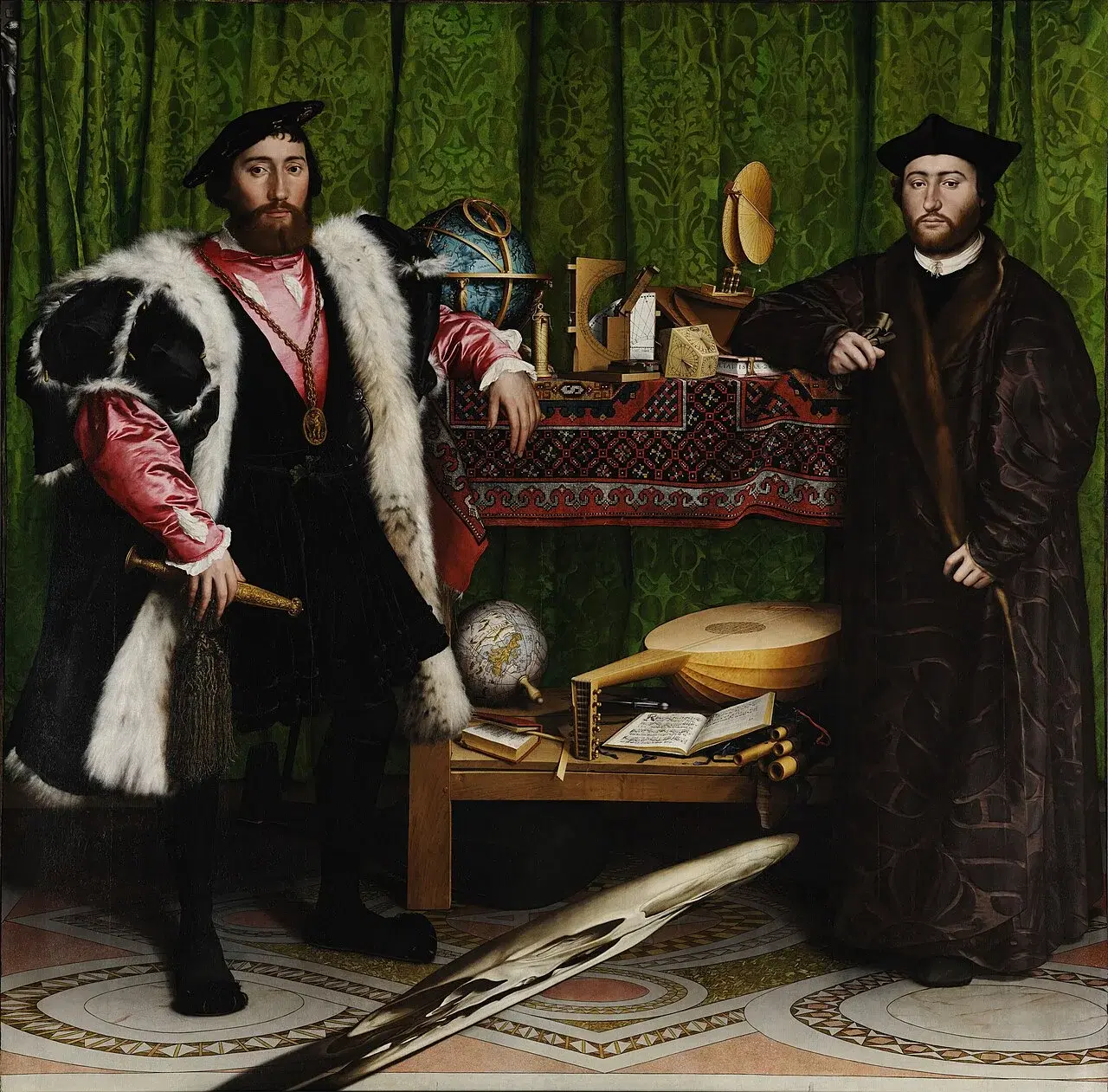
Hans Holbein the Younger was born in Augsburg around 1497, the son of Hans Holbein the Elder, a respected painter of the Swabian school from whom he received his early training. He moved to Basel as a young man and quickly established himself as a supremely versatile artist, producing altarpieces, book illustrations (most famously for Erasmus's Praise of Folly), decorative designs, and portraits. His friendship with the humanist scholar Erasmus of Rotterdam proved decisive: Erasmus's enthusiastic recommendations opened doors in England.\n\nHolbein first visited England in 1526–28 with an introduction to Thomas More, whose family he painted in a work that established his reputation at the English court. He returned to England permanently in 1532, and by 1536 was appointed King's Painter to Henry VIII. In this role he produced the iconic images by which Henry and his court are still recognized: the monumental frontal portrait of Henry himself, the portraits of Jane Seymour, Anne of Cleves (painted in Flanders to assist the king's marriage negotiations), Christina of Denmark, and dozens of courtiers, diplomats, and merchants. His ability to render silk, fur, jewels, and flesh with equal conviction, and to capture psychological character within a framework of formal authority, made him the supreme portraitist of the Northern Renaissance.\n\nHolbein also produced one of the most discussed paintings of the sixteenth century, The Ambassadors (1533), with its celebrated anamorphic skull stretched across the foreground. He died in London in 1543, almost certainly of plague, at around forty-five years of age. His portraits defined the visual identity of the Tudor age and set a standard for formal portraiture that endured for two centuries.
Did you know?
The German master who became the defining visual chronicler of Henry VIII's England, creating portraits of such psychological precision and material richness that they remain the Tudor age's most vivid documents.
Don’t stop here
More to explore by Hans Holbein the Younger