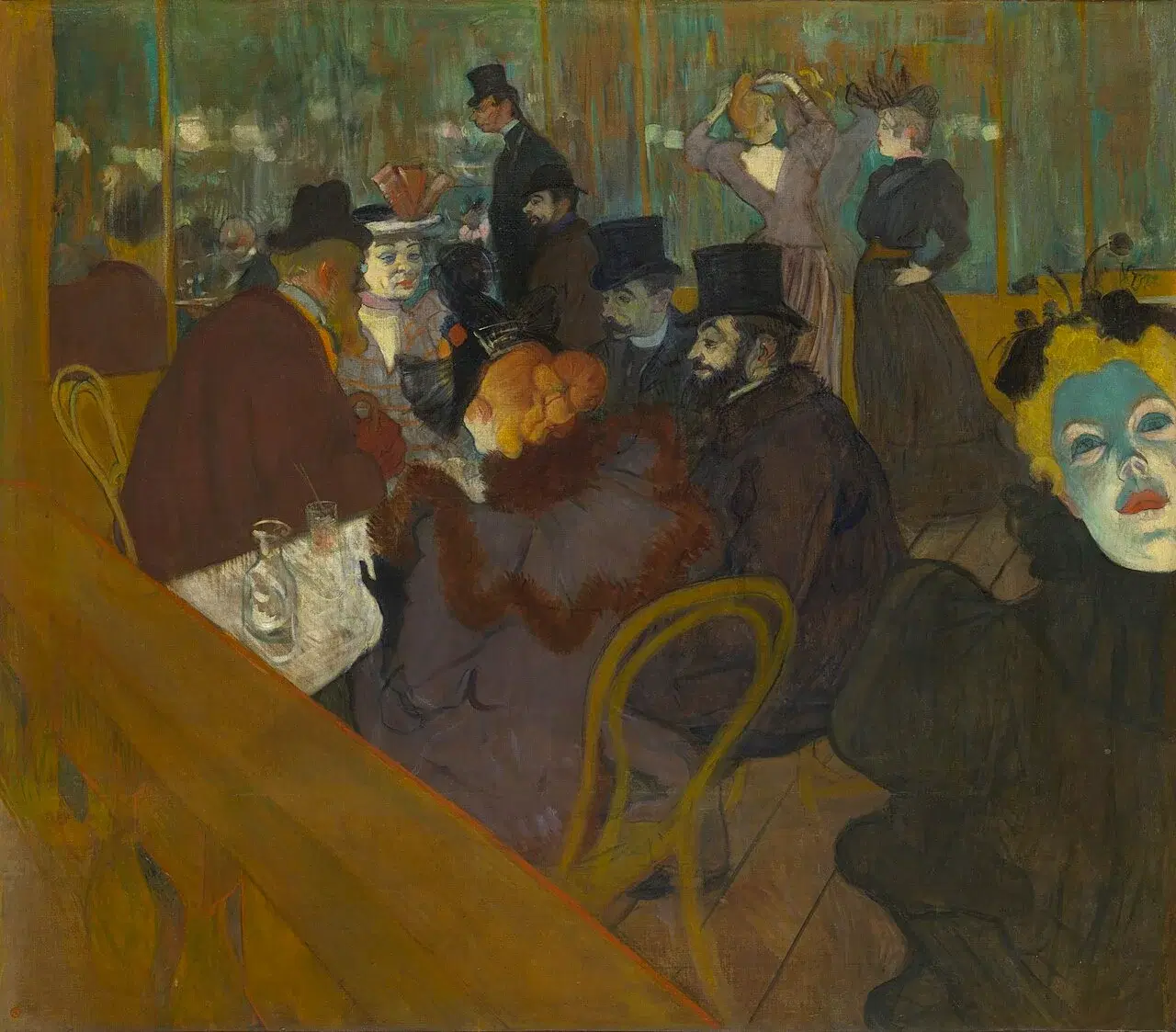
Henri de Toulouse-Lautrec
- 1864 – 1901
- French
- Post-Impressionism
A brief story
Henri de Toulouse-Lautrec was a French Post-Impressionist painter, illustrator, and printmaker born in 1864 in Albi, in the south of France, to an aristocratic family of ancient lineage. Two adolescent accidents left his legs permanently stunted — a consequence likely exacerbated by a hereditary bone condition resulting from his parents' consanguinity — and the resulting disability, combined with the social freedoms of Montmartre, shaped both his life and his art. Moving to Paris in the early 1880s, he immersed himself in the bohemian world of cabarets, cafés, brothels, and circuses, becoming a keen observer of performers and outcasts who inhabited a world he could enter but never fully belong to.\n\nToulouse-Lautrec's work is inseparable from the nocturnal energy of Belle Époque Paris. He became the unofficial visual chronicler of venues such as the Moulin Rouge, the Folies Bergère, and the Divan Japonais, producing vivid oil paintings as well as a celebrated series of lithographic posters that revolutionized commercial art and elevated advertising to a fine art form. His images of Jane Avril, Yvette Guilbert, and Aristide Bruant are among the most iconic of the era. Influenced by Japanese woodblock prints, Degas's cropped compositions, and Impressionist color, he developed a style of fluid line and bold silhouette that anticipates Art Nouveau and twentieth-century graphic design. Destroyed by alcoholism, he died in 1901 at the age of thirty-six.
Did you know?
The poet of Parisian nightlife, Toulouse-Lautrec captured the cabaret world of Belle Époque Montmartre with biting empathy and revolutionary graphic invention, leaving behind work that transformed both fine art and commercial design.
Don’t stop here
More to explore by Henri de Toulouse-Lautrec