James Ensor
- 1860 – 1949
- Belgian
- Expressionism, Symbolism
A brief story
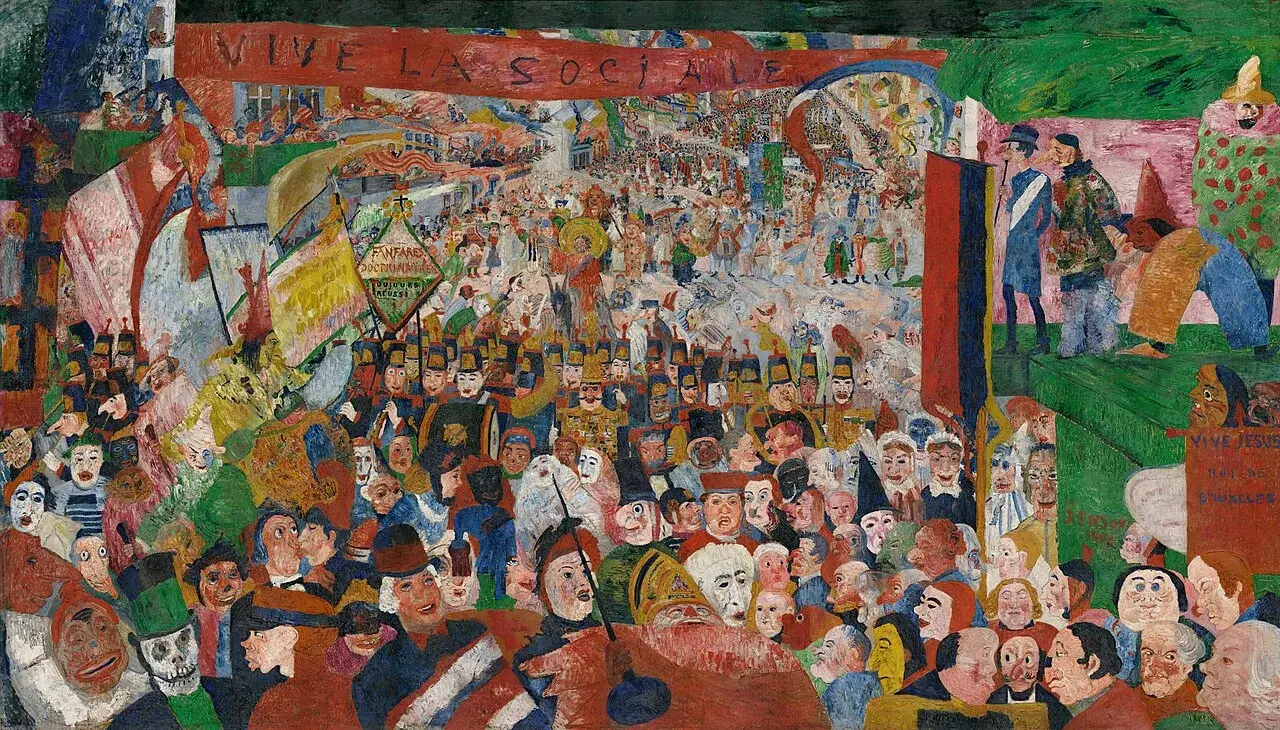
James Sidney Edouard Ensor was born on April 13, 1860, in Ostend, Belgium, a coastal resort town whose carnival traditions — masks, skeletons, and grotesque festivity — would leave a permanent imprint on his imagination. He studied at the Académie Royale des Beaux-Arts in Brussels and, returning to Ostend, began developing a radically original style that positioned him far ahead of his time. His early interiors, bathed in pearlescent light, gave way to increasingly hallucinatory imagery populated by masked figures, demons, and leering skulls.\n\nEnsor's most celebrated work, The Entry of Christ into Brussels in 1889 — a vast, teeming canvas depicting a modern carnival procession with Christ reduced to a marginal figure in the crowd — was rejected by his own avant-garde group Les Vingt as too scandalous to exhibit. It would later be recognised as a masterpiece anticipating Expressionism, social satire, and even aspects of Pop Art. Though he lived until 1949 and received belated official recognition — including elevation to the rank of baron — most of his radical, visionary work was produced before 1900. He remains a singular and undersung figure in the history of modern art.
Did you know?
James Ensor populated his canvases with masks, skeletons, and carnival grotesquerie, creating a uniquely Belgian vision that anticipated Expressionism by decades.
Don’t stop here
More to explore by James Ensor