Jean-François Millet
- 1814 – 1875
- French
- Naturalism, Realism
A brief story
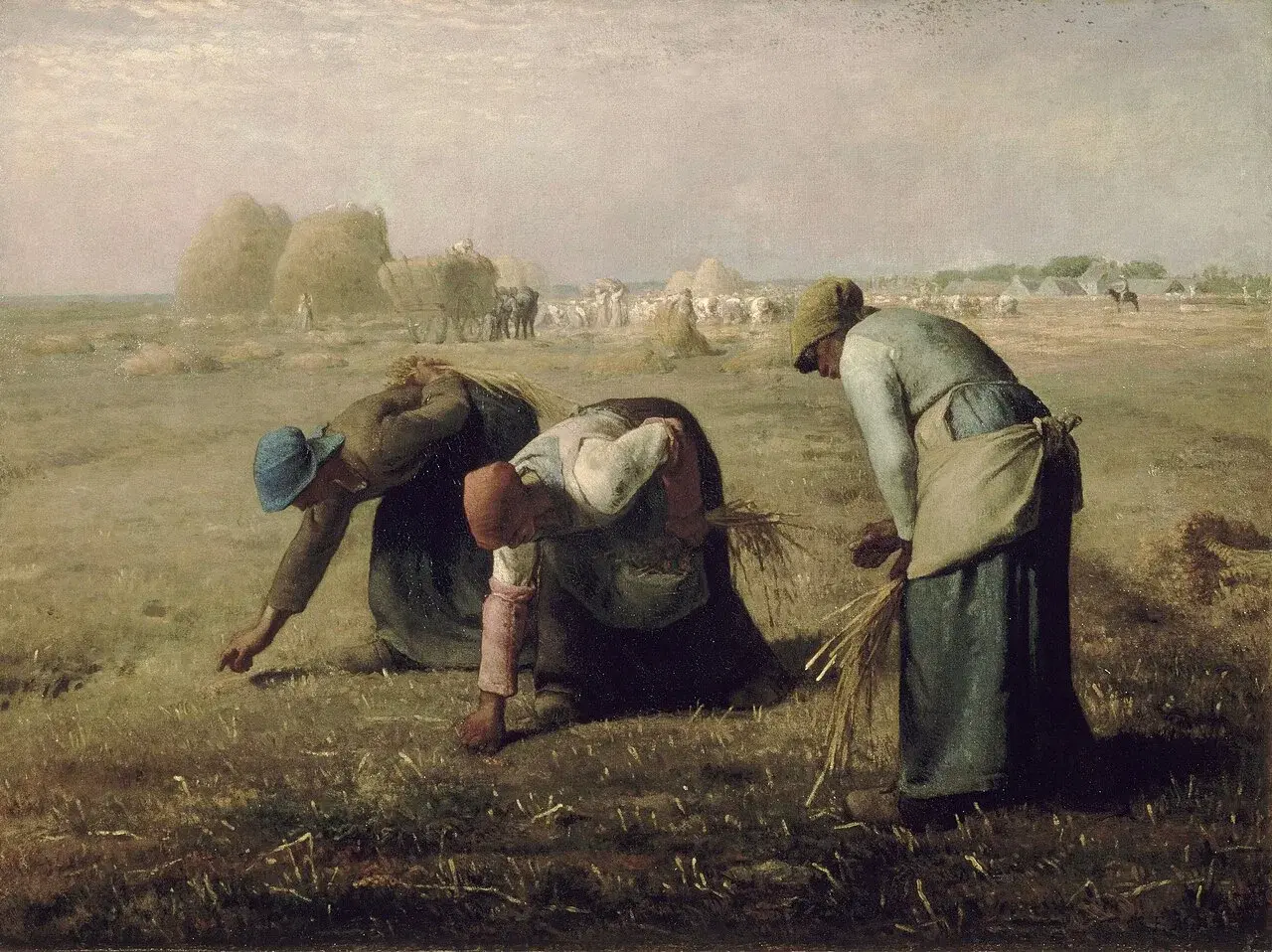
Jean-François Millet was a French painter and one of the founders of the Barbizon School, celebrated for his dignified and empathetic portrayals of rural peasant life. Born in 1814 in Gruchy, a farming village in Normandy, Millet grew up intimately acquainted with agricultural labor, an experience that would define his artistic vision throughout his life. He moved to Paris to study under Paul Delaroche but found himself at odds with the fashionable history painting of the capital, drawn instead to the humble and the elemental.\n\nIn 1849, Millet settled in Barbizon on the edge of the Forest of Fontainebleau, where he would remain for the rest of his life. His paintings of peasants sowing, gleaning, and tending flocks — among them The Gleaners (1857) and The Angelus (1857–59) — were radical in their choice of subject and monumental in their treatment of it. Where academic painters sentimentalized rural poverty or ignored it entirely, Millet rendered it with solemn grandeur, giving his subjects a gravity previously reserved for religious or historical figures.\n\nHis work was initially received with suspicion by critics who detected socialist sympathies in his imagery, though Millet himself was more interested in spiritual and universal themes than in political polemic. His influence proved enormous: Vincent van Gogh revered him deeply and made copies of his compositions, while his vision of the laboring poor anticipated the Social Realist tradition. Millet died in Barbizon in 1875, his reputation firmly established as one of the great humanist painters of the nineteenth century.
Did you know?
French Realist painter Jean-François Millet elevated the peasant farmer to the status of a monumental, almost sacred figure, producing some of the nineteenth century's most enduring images of rural life and human dignity.
Don’t stop here
More to explore by Jean-François Millet