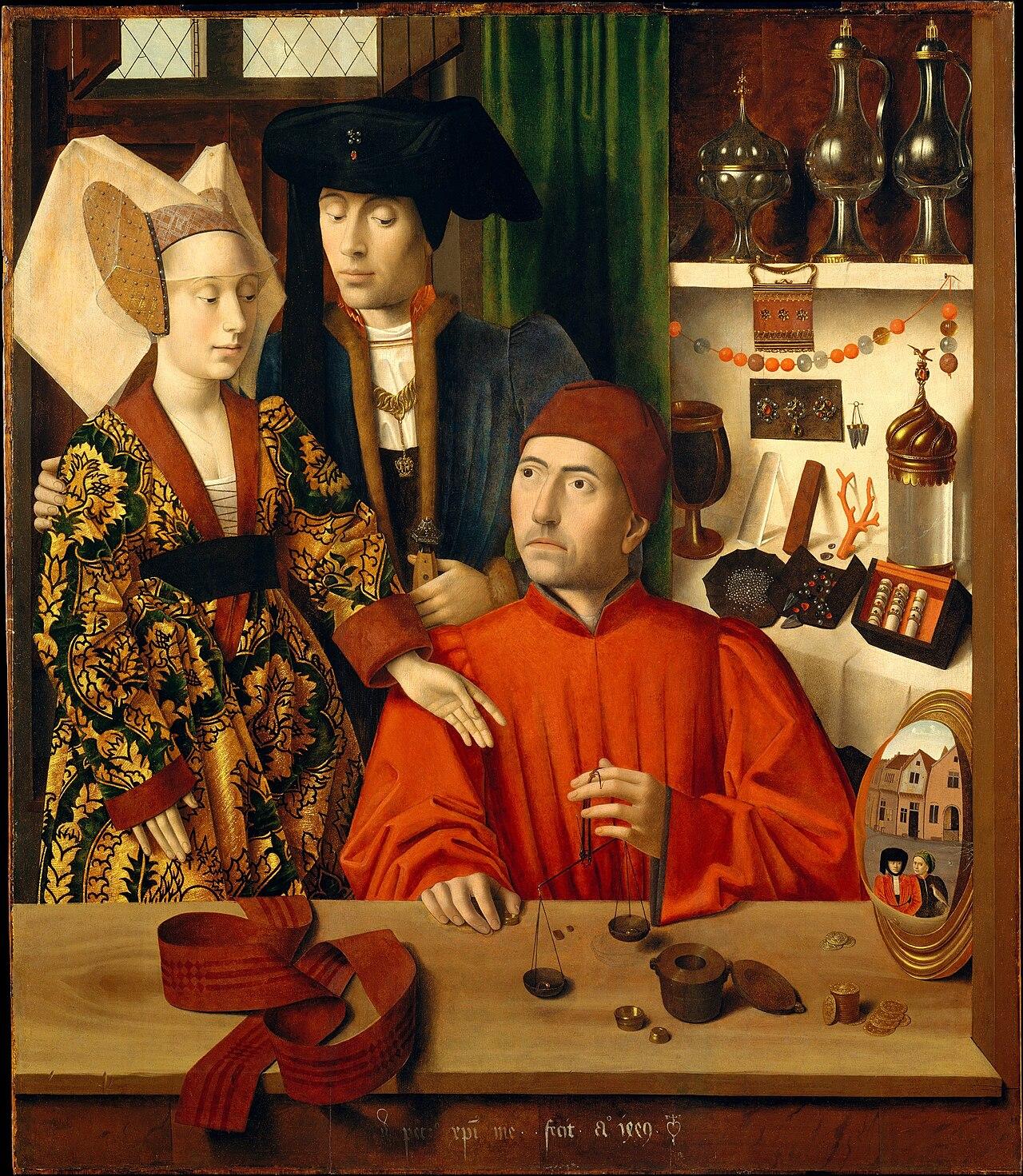
Petrus Christus
- 1410 – c. 1475
- Belgian
- Northern Renaissance
A brief story
Petrus Christus was a Flemish Early Netherlandish painter active in Bruges during the mid-fifteenth century, widely considered one of the most important successors to Jan van Eyck. Born around 1415 in Baerle, in what is now the Netherlands-Belgium border region, he became a citizen of Bruges in 1444 and registered as a master painter there. His early training and the precise location of his apprenticeship remain matters of scholarly debate, though his work shows deep familiarity with the innovations of Van Eyck and Rogier van der Weyden.\n\nChristus made significant technical advances in the depiction of space and light, and is credited by some art historians with being among the first Flemish painters to employ a coherent system of one-point linear perspective. His 'Portrait of a Young Girl' (c. 1470) in the Gemäldegalerie, Berlin, is particularly celebrated for its psychological intimacy and its revolutionary treatment of the sitter in three-dimensional space rather than against a flat ground. His religious panels — including altarpieces and devotional diptychs — display a careful attention to material surfaces: the gleam of gold, the texture of velvet, the translucency of skin. He died in Bruges around 1476, leaving an influential body of work that bridges the generation of Van Eyck and the mature Flemish tradition.
Did you know?
A pivotal Early Netherlandish master, Petrus Christus brought spatial depth and psychological intimacy to Flemish panel painting, building on the legacy of Van Eyck in fifteenth-century Bruges.
Don’t stop here
More to explore by Petrus Christus