Thomas Eakins
- 1844 – 1916
- American
- Realism
A brief story
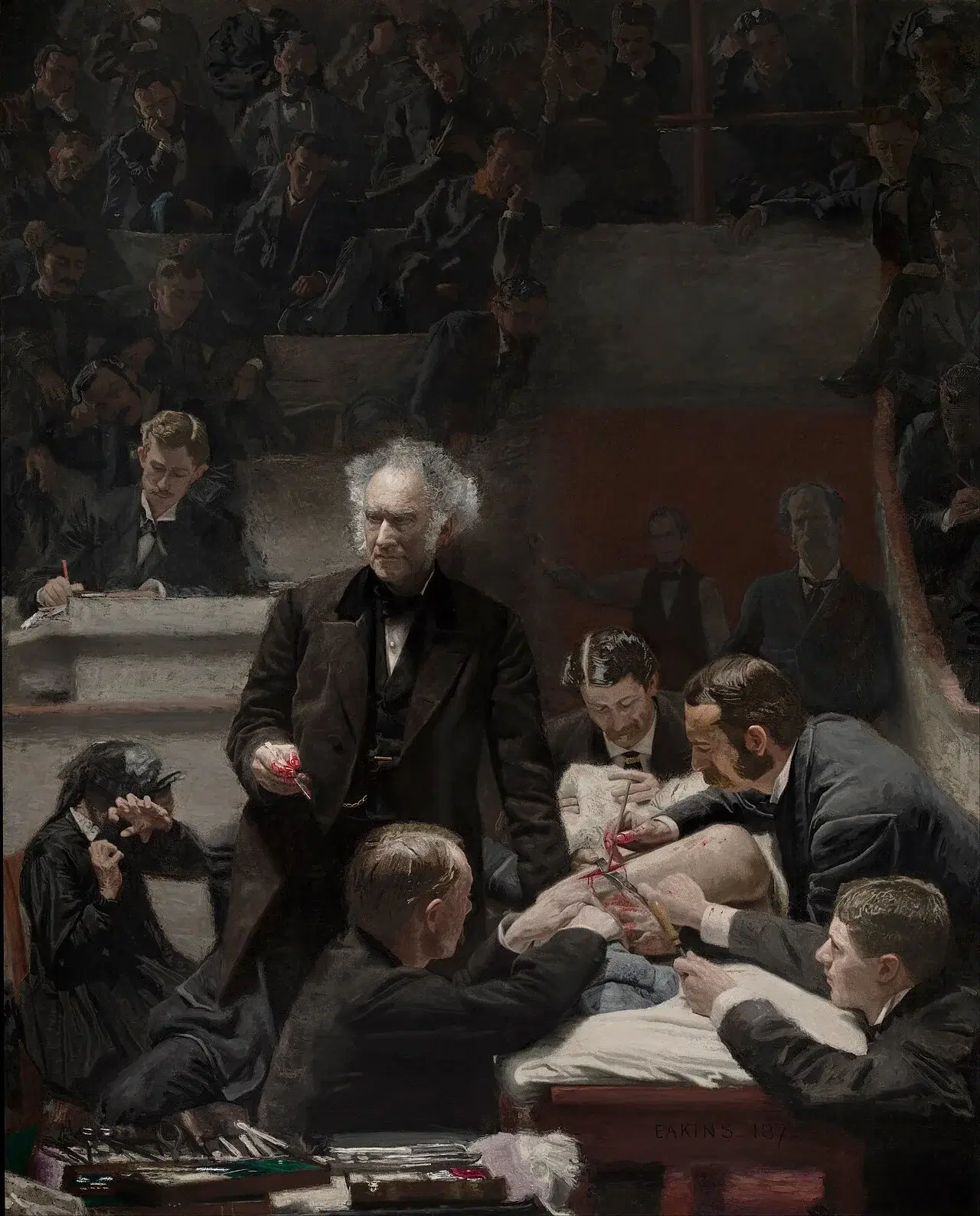
Thomas Eakins was born in Philadelphia in 1844 and became the most intellectually rigorous and uncompromising realist painter America has produced. He studied at the Pennsylvania Academy of the Fine Arts and later in Paris under Jean-Léon Gérôme, absorbing academic discipline and a deep reverence for the human figure. Returning to Philadelphia, he devoted himself to painting subjects drawn from contemporary American life — rowers on the Schuylkill River, surgeons at work, wrestlers, boxers, and the quiet dignity of ordinary men and women — rendered with an almost scientific intensity.\n\nEakins was a passionate student of anatomy, physiology, and the new science of motion photography, and his teaching methods at the Pennsylvania Academy — which included having students work from nude models — generated considerable controversy that eventually forced his resignation in 1886. His masterpiece, The Gross Clinic (1875), depicting a surgical operation in graphic detail, was considered too disturbing for exhibition alongside fine art and was hung in a medical pavilion instead. Largely unappreciated during his lifetime, Eakins is now recognized as a towering figure in American art, admired for his refusal to flatter or sentimentalize and his insistence on depicting the human body and human endeavor with absolute honesty.
Did you know?
Thomas Eakins brought a physician's unflinching honesty to American realist painting, insisting on depicting the human body and human endeavor exactly as they are — a standard that cost him dearly in his own time.
Don’t stop here
More to explore by Thomas Eakins