Blue Poles
Artwork Specifications
- Medium
- Mixed Media
- Genre
- Abstract
- Style
- Abstract Expressionism
- Location
- National Gallery of Victoria
Meet the artist
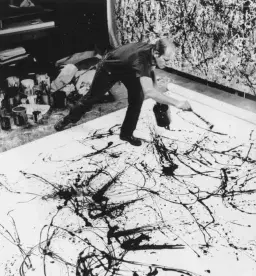
Jackson Pollock1912–1956 · American“I have no fear of making changes, destroying the image, etc., because the painting has a life of its own.”
Where to see it
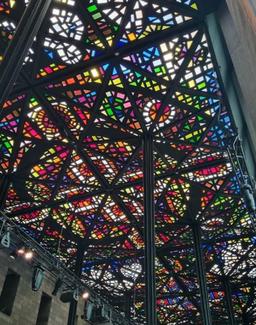
National Gallery of Victoria
Melbourne, AustraliaJackson Pollock's Blue Poles, completed in 1952 and originally titled Number 11, 1952, is widely regarded as one of the defining masterpieces of Abstract Expressionism. The vast canvas — over four metres wide and more than two metres tall — is a dense, pulsating web of poured and dripped household paint: skeins of black, white, yellow, orange, and red interweave across the surface with extraordinary energy, overlaid by eight dark blue diagonal poles that give the work its familiar name. Pollock arrived at the image through his celebrated drip technique, working on the canvas as it lay on the studio floor, moving around and across it as he poured, flicked, and flung the paint.\n\nThe painting entered the collection of the National Gallery of Australia in 1973, purchased for US$2 million — a record price for an American work at the time — and approved personally by Prime Minister Gough Whitlam. The acquisition ignited fierce public controversy about the perceived extravagance of spending public funds on abstract art, but posterity has entirely vindicated the decision. Blue Poles is now considered a national treasure and a cornerstone of the Canberra gallery's international holdings, drawing visitors from around the world.