Check Series
Meet the artist
Samuel Bak1933American, Polish
Dates
1970
Specifications
- Movement
- Surrealism
- Medium
- Oil Painting
- Genre
- Allegory, Symbolic Painting
© Samuel Bak
About the Artwork
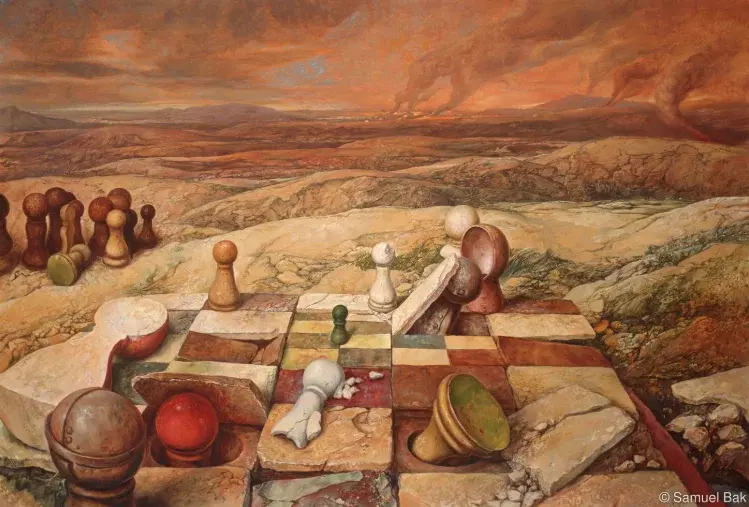
Samuel Bak is a Lithuanian-born Jewish painter whose entire body of work is marked by his survival of the Holocaust and the near-total extermination of his family and community in the Vilna Ghetto. Chess reappears throughout his production as a powerful metaphor for the forces of history: rational systems of strategy and order reduced to rubble, the classical logic of the game crushed by the irrational violence of genocide.
In Checkmate, as in much of his chess series, Bak places broken boards and scattered pieces in desolate, dreamlike landscapes that evoke both postwar devastation and the existential residue of the catastrophe. The pawns and kings of the board become stand-ins for human lives consumed by forces beyond their control; the very concept of checkmate—an inescapable defeat—is transformed into an image of historical tragedy. Bak’s pictorial style combines surrealist iconography with a deeply personal symbolic vocabulary: cracked stone, torn fabric, smoky skies, and the rubble of a destroyed civilization. He has said that he translates the cataclysmic forces of the Holocaust into images of a world after a universal deluge. The work is held in private and institutional collections, and Bak is closely linked to the Pucker Gallery in Boston.
Spotlight
Chess is his great visual symbol: broken pieces, fragmented boards, impossible games. It represents central themes in his work:
→ the Holocaust
→ loss
→ moral chaos
→ the fragility of human order.
It is a broken chessboard where no one wins the game.