Helen Frankenthaler
Basel, Switzerland
Helen Frankenthaler was an American abstract expressionist painter. She was a major contributor to the history of postwar American painting. Having exhibited her work for over six decades (from the early 1950s until 2011), she spanned several generations of abstract painters while continuing to produce vital and ever-changing new works.
Frankenthaler began exhibiting her large-scale abstract expressionist paintings in contemporary museums and galleries in the early 1950s. She was included in the 1964 Post-Painterly Abstraction exhibition, curated by Clement Greenberg, which introduced a newer generation of abstract painting that came to be known as color field. Born in Manhattan, she was influenced by the paintings of Greenberg, Hans Hofmann, and Jackson Pollock. Her work has been the subject of several retrospective exhibitions, including a 1989 retrospective at the Museum of Modern Art in New York City, and has been exhibited worldwide since the 1950s. In 2001, she was awarded the National Medal of Arts.
Frankenthaler was an influential American abstract painter who played a key role in the transition from Abstract Expressionism to Color Field painting.
Her approach deeply influenced artists such as Morris Louis and Kenneth Noland and helped redefine the possibilities of abstraction. Frankenthaler's work is important for expanding the expressive power of color and for breaking new ground in postwar American art, especially for subsequent generations of painters.
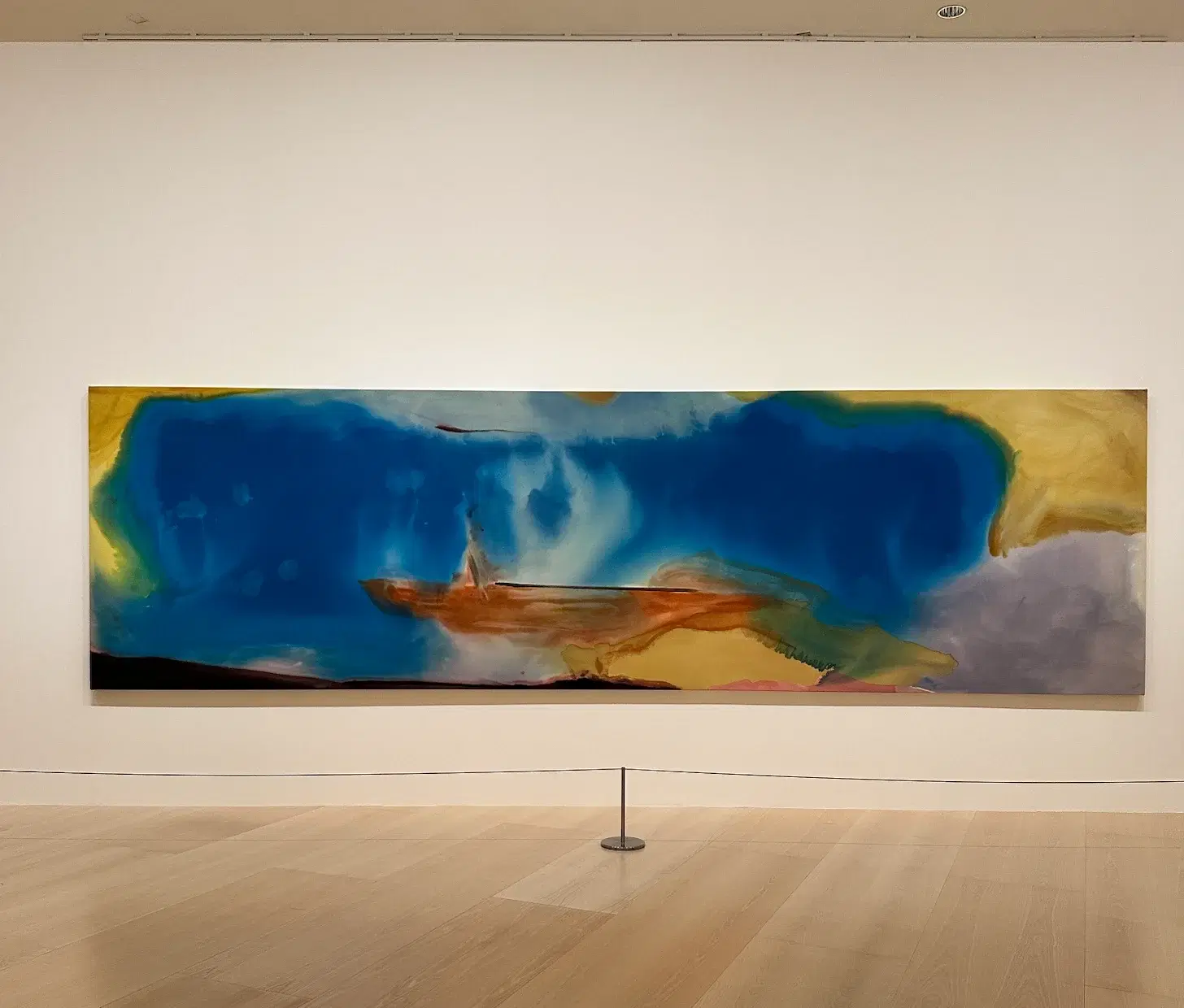
In the early 1950s, she developed the innovative “soak-stain” technique, pouring thinned paint directly onto unprimed canvas, which allowed the color to spread and merge in fluid and luminous ways, allowing it to be absorbed and create fluid and ethereal forms, as in her masterpiece Mountains and Sea
Plan your visit — these exhibitions are on view now.