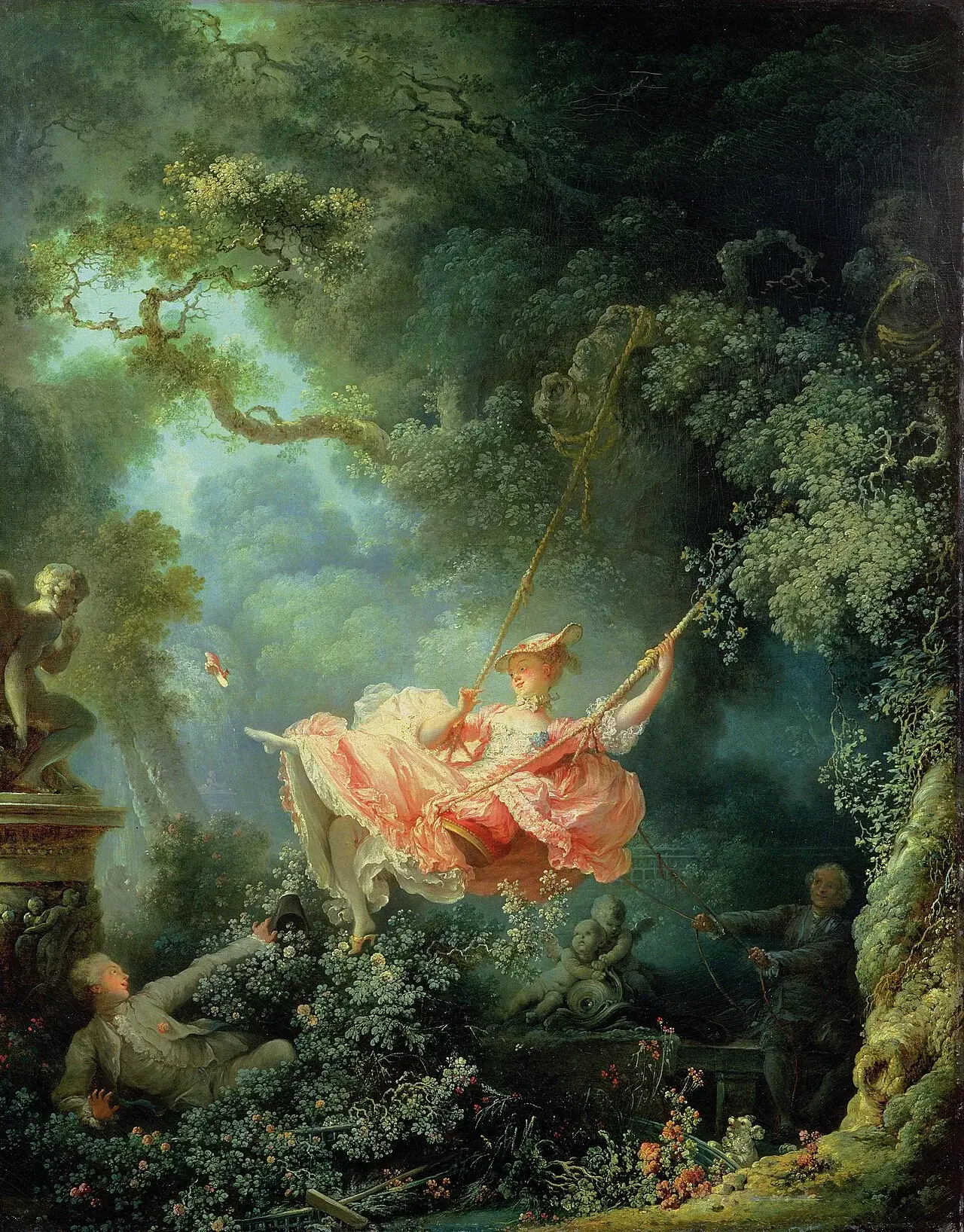
Jean-Honoré Fragonard
- 1732 – 1806
- French
- Rococo
A brief story
Jean-Honoré Fragonard was a French painter who became the supreme master of the Rococo style, producing works of extraordinary lightness, sensuality, and technical brilliance. Born in Grasse in 1732, he trained under Chardin and then Boucher before winning the Prix de Rome in 1752, an award that sent him to Italy where he spent several years absorbing the lessons of the Baroque masters and the Italian landscape. On his return to Paris, he quickly established himself as the painter of choice for the French aristocracy.\n\nFragonard's best-known works — including The Swing (1767) and The Progress of Love series (1771–73) — are emblems of the ancien régime's pleasure-seeking culture, filled with silks, gardens, erotic playfulness, and the soft luminosity of a world devoted to leisure. His handling of paint was remarkably free and spontaneous for its era, and his ability to render diaphanous fabrics, dappled light, and the textures of nature gave his work a freshness that sets it apart from the more formulaic productions of his contemporaries.\n\nThe French Revolution destroyed the world that had sustained Fragonard's career. Aristocratic patronage evaporated, his style fell completely out of fashion, and he spent his final years in obscurity and relative poverty. He died in Paris in 1806, largely forgotten, though the nineteenth century would gradually rediscover and celebrate the extraordinary craftsmanship and hedonistic charm of his best paintings.
Did you know?
Jean-Honoré Fragonard was the consummate painter of French Rococo pleasure, whose canvases of gardens, silk, and erotic play captured the glittering sensibility of aristocratic life just before the Revolution swept it away.
Don’t stop here
More to explore by Jean-Honoré Fragonard