Kazimir Malevich
- 1879 – 1935
- Russian
- Cubism, Modernism, Suprematism
A brief story
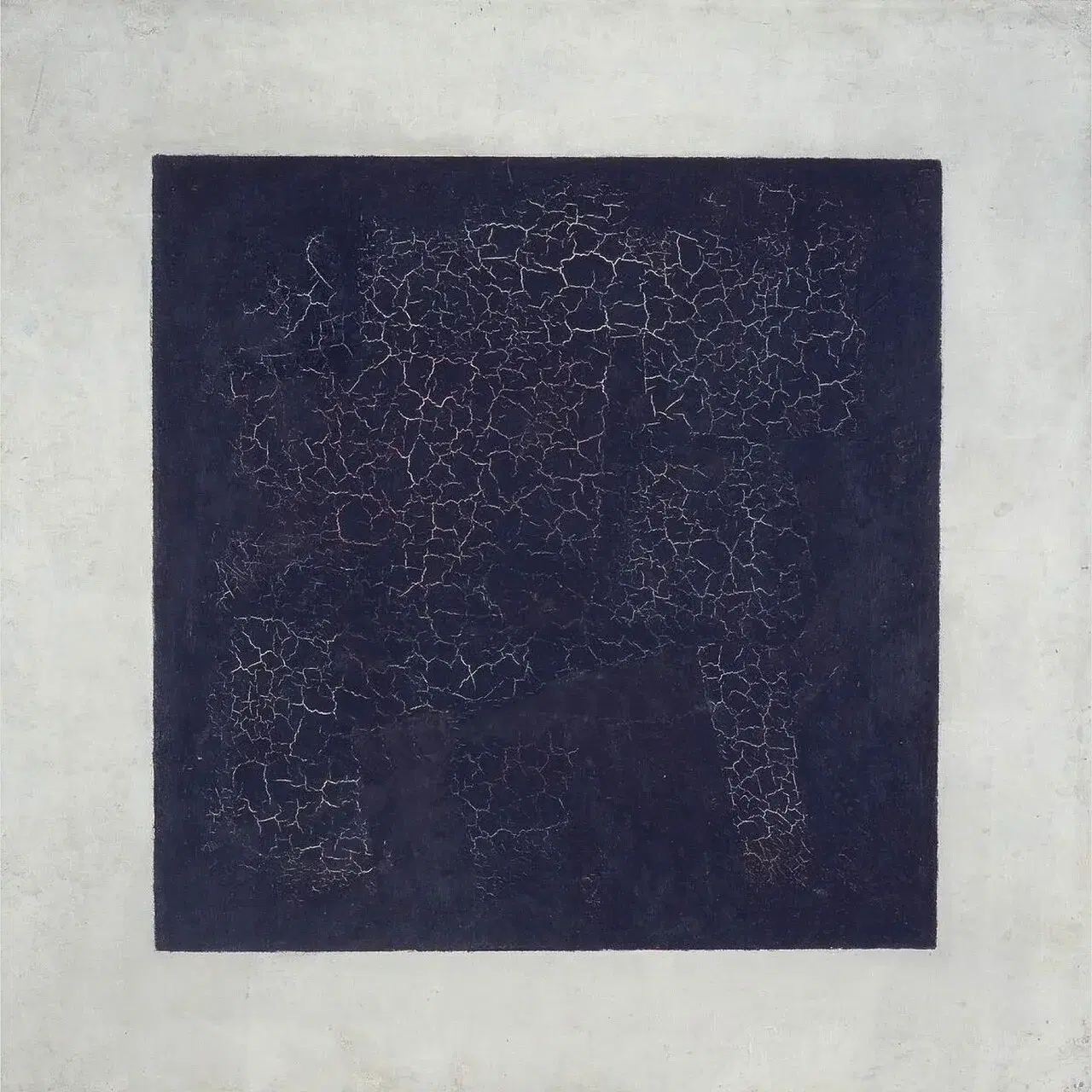
Kazimir Severinovich Malevich was born in Kyiv in 1878 to Polish parents and grew up in various Ukrainian cities before settling in Moscow around 1904. He pursued painting through the Moscow School of Painting, Sculpture, and Architecture and threw himself into successive waves of the Russian avant-garde, moving rapidly through Impressionism, Symbolism, and a Russian variant of Cézannism before engaging with Cubism and Futurism in the early 1910s.\n\nIn 1915, at the landmark exhibition 0.10 in Petrograd, Malevich unveiled Suprematism: an art of pure geometric sensation stripped of all representational content. The centerpiece was Black Square — a black quadrilateral on a white ground — hung in the corner of the gallery where icons traditionally hang, a deliberate act of metaphysical provocation. He argued that art must free itself from the world of objects and serve only the supreme reality of pure feeling. His Suprematist compositions — hovering rectangles, circles, and crosses in black, red, and white against white grounds — remain among the most radical gestures in art history. The culmination, White on White (1918), reduced painting to near-nothingness.\n\nAfter the Russian Revolution Malevich was active in Soviet art institutions and education, but his fortunes declined as Socialist Realism became official doctrine in the late 1920s. His work was condemned as 'formalist,' and he was briefly arrested in 1930. He died of cancer in Leningrad in 1935. Buried in a Suprematist coffin he designed himself, he left an intellectual legacy — the idea that pure form and color could carry absolute meaning — that has shaped abstract art, design, and architecture to the present day.
Did you know?
The Russian radical who reduced painting to pure geometric sensation, hanging a black square in place of an icon and launching Suprematism as a new philosophy of art.
Don’t stop here
More to explore by Kazimir Malevich