Robert Campin
- 1375 – 1444
- Belgian
- Northern Renaissance
A brief story
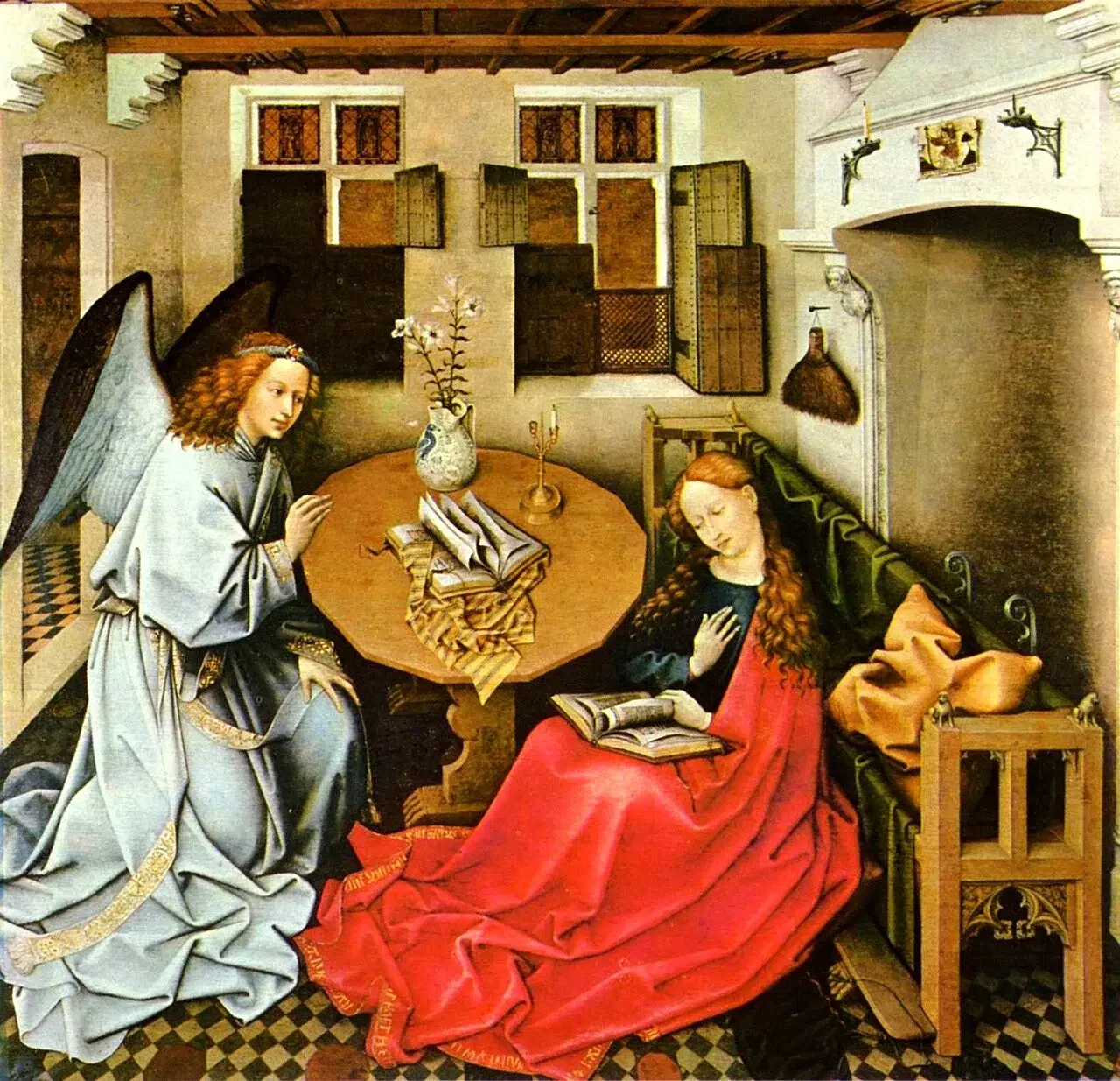
Robert Campin was a Flemish painter active in Tournai (in present-day Belgium) and is widely identified with the anonymous artist known as the Master of Flémalle, one of the pioneers of Early Netherlandish painting and a key figure in the revolution in northern European art that took place around 1420. His exact biography is reconstructed largely from civic and guild records, which document his prominent status in Tournai — he served as dean of the painters' guild — and several legal proceedings that included a conviction for moral misconduct in 1429.\n\nCampin's most celebrated work is the Mérode Altarpiece (c.1425–28), a triptych now in the Metropolitan Museum of Art in New York depicting the Annunciation set not in a timeless sacred space but in a detailed, convincingly rendered middle-class Flemish domestic interior, with a burning candle, a copper basin, and tools visible on a shelf. This radical relocation of sacred events into recognizable, contemporary everyday life was one of the defining innovations of the Early Netherlandish school, and it gives Campin's work a directness and warmth quite different from the more courtly elegance of his near-contemporary Jan van Eyck.\n\nCampin's studio in Tournai was an important center of artistic training; the great Rogier van der Weyden is documented as having trained there, a fact that has profoundly shaped how art historians understand the transmission of Early Netherlandish style. The precise relationship between Campin's surviving works, the paintings attributed to the Master of Flémalle, and the workshop production of his studio remains a matter of scholarly debate, but his foundational importance to northern European painting of the fifteenth century is unquestioned.
Did you know?
Robert Campin pioneered the Early Netherlandish revolution by placing sacred scenes inside warmly observed Flemish domestic interiors, bringing a new intimacy and realism to northern European painting that would influence generations of artists.
Don’t stop here
More to explore by Robert Campin