William Blake
- 1757 – 1827
- British
- Romanticism
A brief story
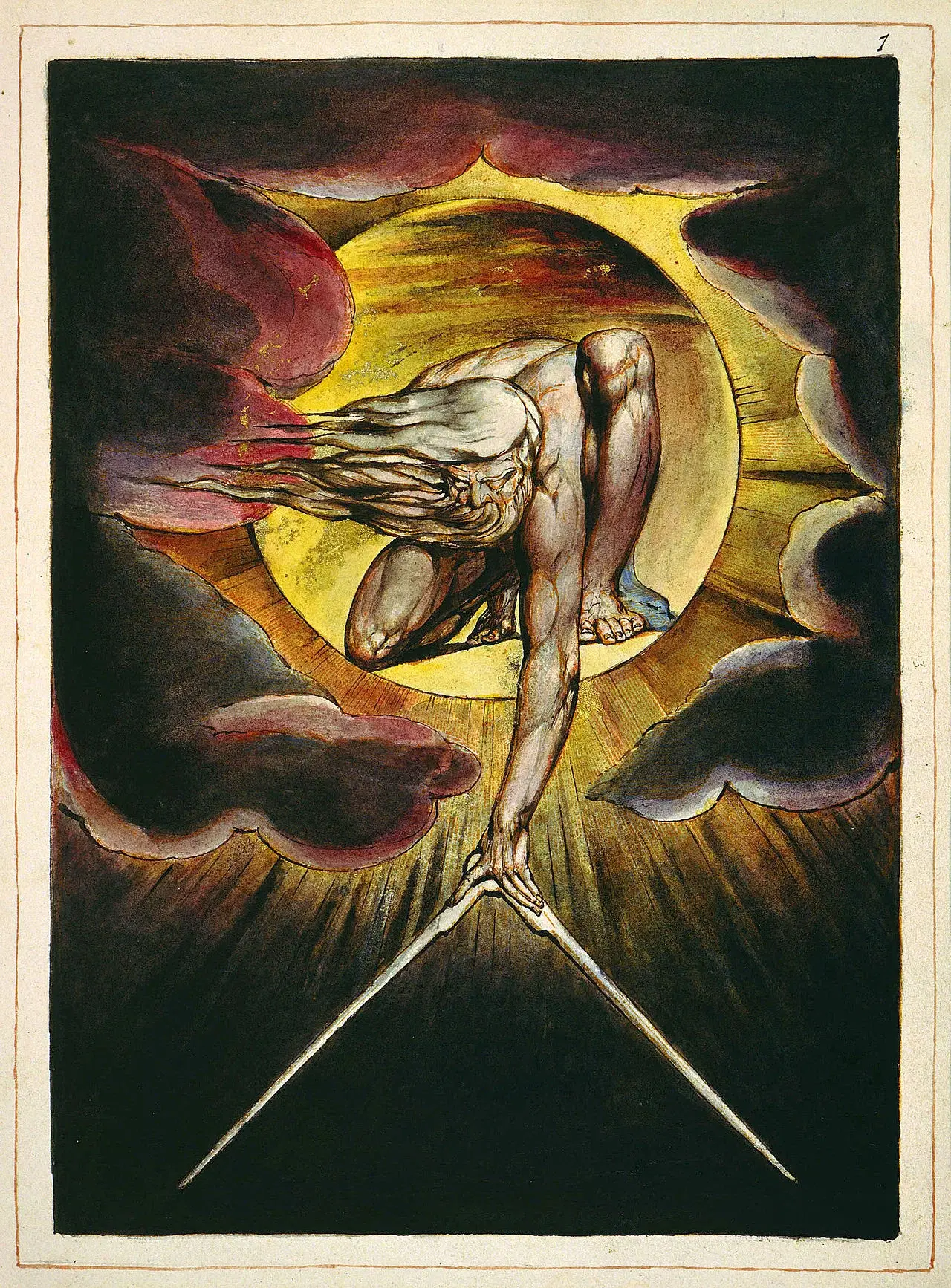
William Blake was an English poet, painter, and printmaker born in London in 1757, now recognized as a foundational figure of the Romantic Age and one of the most original creative minds in British history. The son of a hosier, he showed extraordinary gifts from childhood, reportedly experiencing visions of angels in the trees of Peckham Rye. He trained as an engraver under James Basire and later studied briefly at the Royal Academy, though he rejected academic orthodoxy throughout his life. His inner spiritual world — a self-invented mythology populated by titanic figures such as Urizen, Los, and Albion — informed both his poetry and his visual art.\n\nBlake developed a unique method he called 'relief etching' (or 'illuminated printing'), through which he combined handwritten text and hand-drawn images on copper plates to produce books of extraordinary visual coherence. Works such as 'Songs of Innocence and of Experience,' 'The Marriage of Heaven and Hell,' and the epic 'Jerusalem' blend visionary verse with richly colored illustration in a form unlike anything before or since. Despite living in obscurity for much of his life and selling almost nothing, he continued to work prolifically, producing large watercolor series illustrating Dante, Milton, and the Book of Job in his final years. He died in 1827, singing hymns, and was buried in an unmarked grave; later generations enshrined him as a prophet and artist of singular power.
Did you know?
Poet, painter, and prophet, William Blake forged an entirely personal mythology in verse and illuminated print, becoming one of the most visionary and unclassifiable figures of the Romantic era.
Don’t stop here
More to explore by William Blake