Wassily Kandinsky
- 1866 – 1944
- Russian
- Abstract Expressionism, Expressionism, Modernism
A brief story
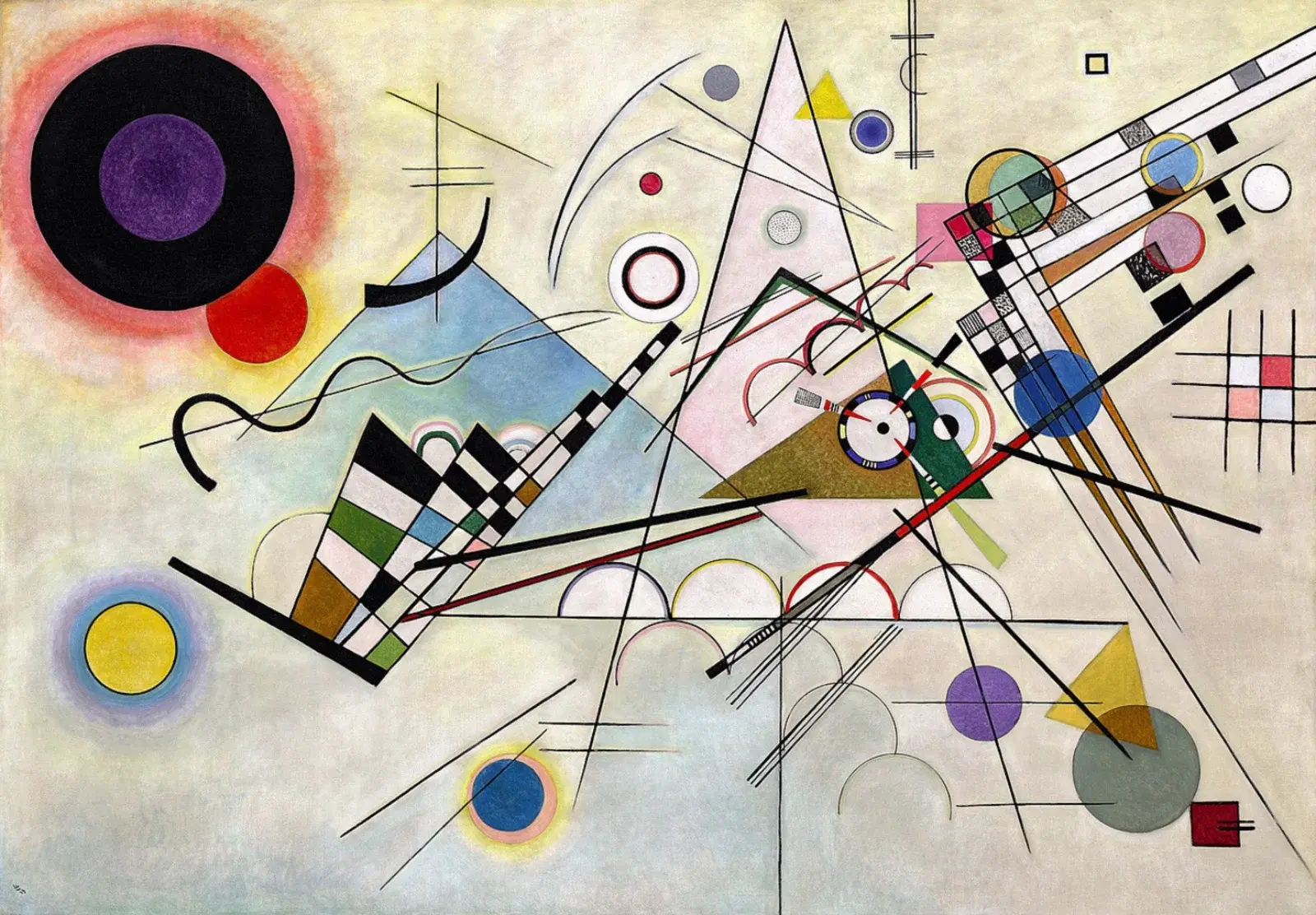
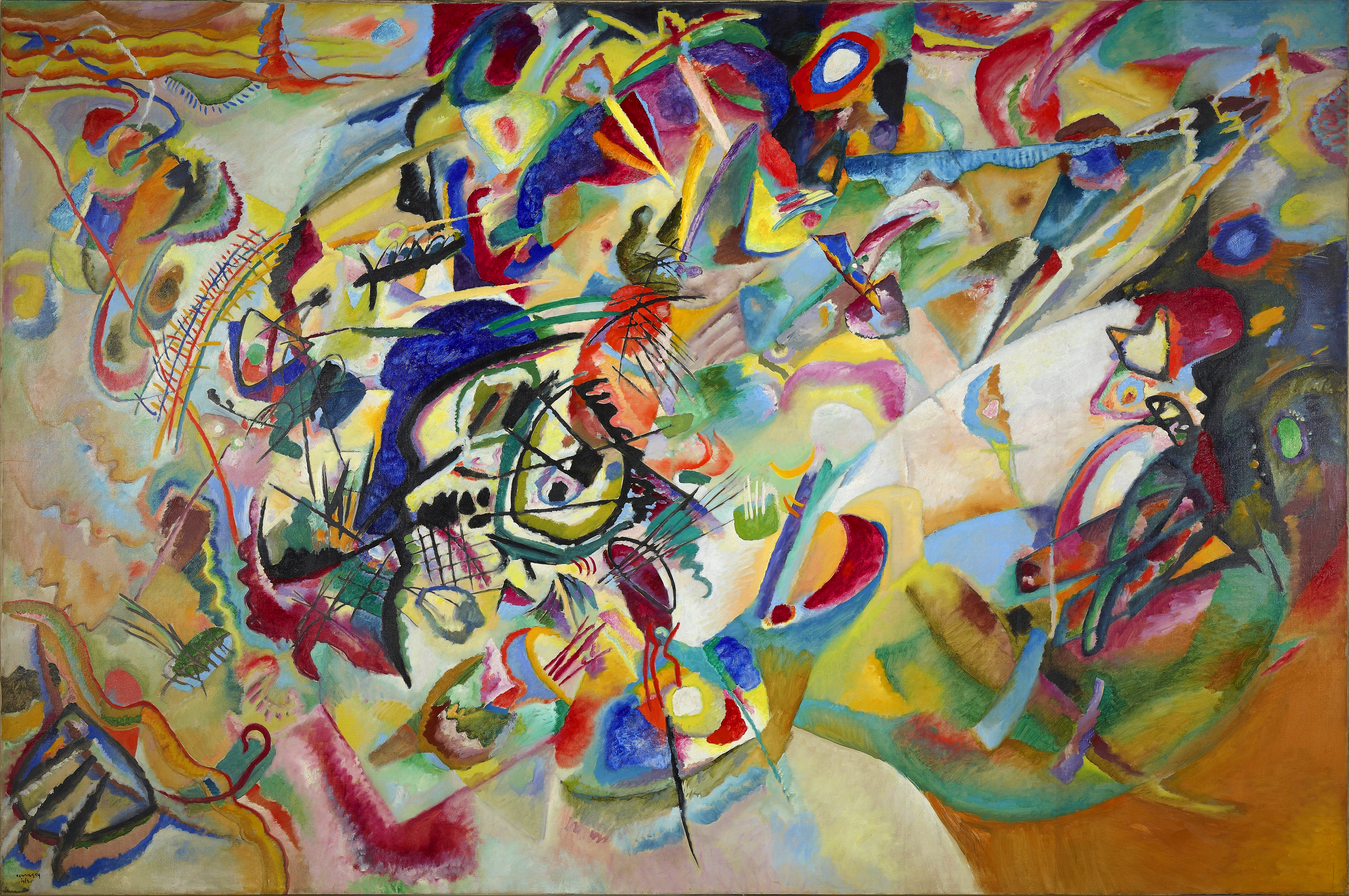
Wassily Kandinsky was born in Moscow in 1866 and raised partly in Odessa. He studied law and economics at Moscow University and showed considerable promise as a legal scholar before, at the age of thirty, abandoning an academic career to study painting in Munich. He trained under Anton Ažbe and Franz von Stuck, then immersed himself in the Munich avant-garde, co-founding the Neue Künstlervereinigung München in 1909 and later the influential Der Blaue Reiter almanac with Franz Marc in 1911.\n\nKandinsky is widely credited as the first painter to make a fully non-objective, abstract work. Inspired by the emotional resonances of color and the analogy between painting and music — he was a skilled cellist and had experienced synesthesia — he progressively stripped representation from his canvases between roughly 1908 and 1913. His theoretical writings, particularly Concerning the Spiritual in Art (1911) and Point and Line to Plane (1926), provided a rigorous philosophical foundation for abstraction that influenced artists across Europe and beyond. After the Russian Revolution, he returned to Moscow to help reshape art education before emigrating to Germany to teach at the Bauhaus in Weimar and then Dessau from 1922 to 1933.\n\nWhen the Nazis closed the Bauhaus, Kandinsky settled in Neuilly-sur-Seine near Paris, where he spent his final decade producing increasingly biomorphic, playful compositions. He died in 1944. His long, restless career encompassed Fauvism, Expressionism, geometric abstraction, and organic abstraction, and his founding theoretical claim — that color and form could carry spiritual meaning independent of subject matter — remains the bedrock of abstract art.
Did you know?
The Russian-born visionary who abandoned a legal career to pioneer pure abstraction, becoming the first painter to liberate art entirely from visible reality.
Don’t stop here