Christ of Saint John of the Cross
Artwork Specifications
- Dimensions
- 205 × 116 cm
Meet the artist
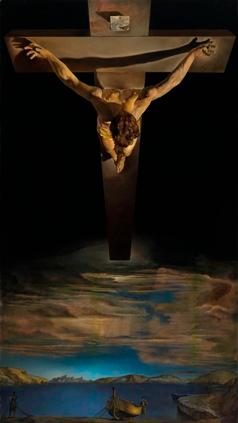
Salvador Dali's striking depiction of the Crucifixion presents Christ from a dramatic overhead perspective, suspended on a cross that floats above a darkened bay at Port Lligat, the artist's home on the Catalan coast. Below, fishermen tend to a small boat on the tranquil water, unaware of the cosmic event above them. The composition conspicuously omits the conventional elements of suffering: there are no nails, no blood, no crown of thorns.
Dali claimed the image came to him in a "cosmic dream" in 1950, in which he perceived the scene as the nucleus of an atom representing the unity of the universe. The painting's title references a small sixteenth-century crucifixion sketch by the Spanish mystic Saint John of the Cross, which provided the unusual downward-looking viewpoint. To achieve anatomical accuracy for this extreme angle, Dali hired Hollywood stuntman Russell Saunders, suspending him from a gantry to study how gravity affected the body's position.
The geometric structure is deliberate: Christ's outstretched arms form a triangle symbolizing the Trinity, while his bowed head creates a circle suggesting unity. Glasgow's Kelvingrove Museum purchased the painting in 1952 for 8,200 pounds, a decision that provoked protests from local art students but ultimately gave the city one of its most beloved artworks, voted Scotland's favourite painting in 2006.