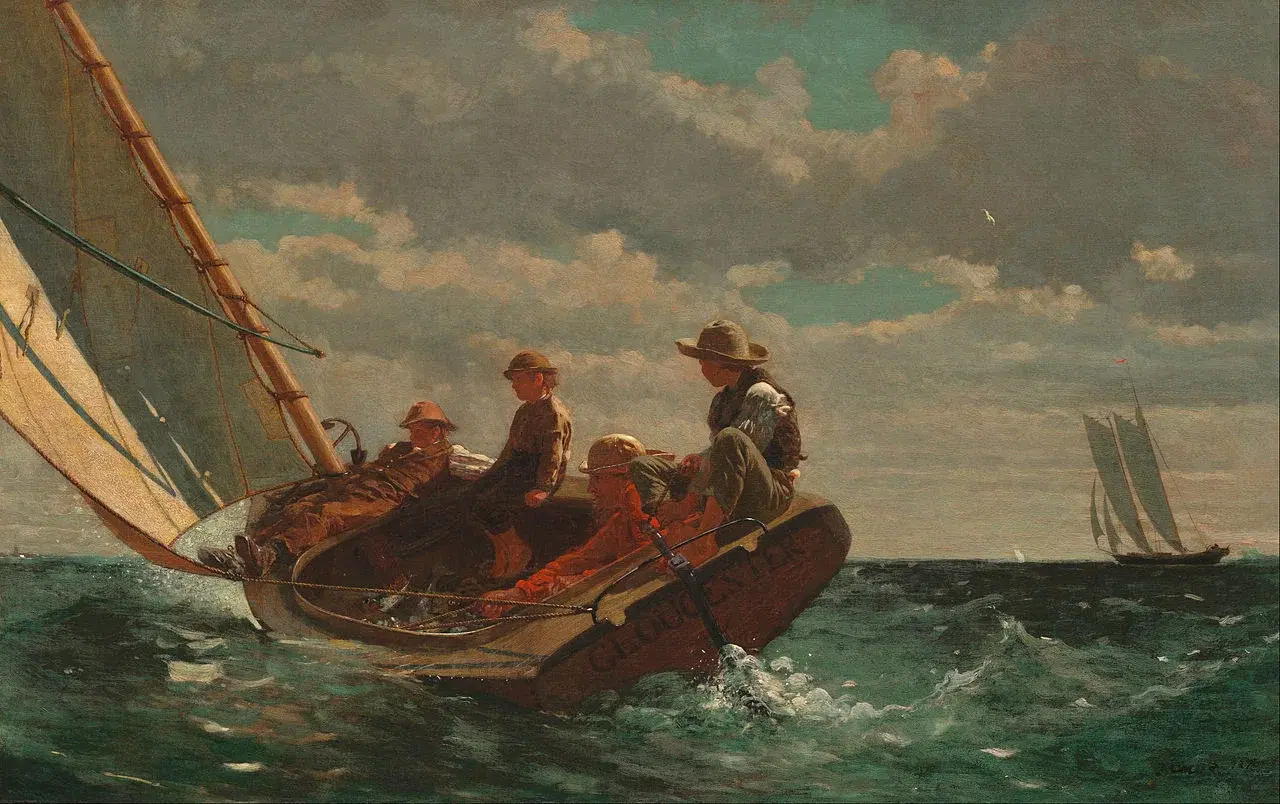
Breezing Up (A Fair Wind)
Meet the artist
WWinslow Homer1836–1910American
Dates
1873–1876
Specifications
- Movement
- Realism
- Medium
- Oil Painting
- Genre
- Genre Painting, Seascape
About the Artwork
Winslow Homer's Breezing Up (A Fair Wind), worked on between 1873 and 1876, has become one of the most beloved paintings in American art — an image that seems to capture the spirit of a nation in its centennial year. The canvas shows a weathered fisherman and three young boys sailing a catboat through the choppy waters of Gloucester Harbor, Massachusetts, leaning hard into a stiff, invigorating wind. Their catch lies at their feet; a schooner makes way in the middle distance. Every element — the taut sail, the heeled hull, the boys' animated postures — communicates the exhilarating freedom of a life lived close to the sea.\n\nHomer began the composition in New York using watercolour studies made during visits to Gloucester and refined it over three years, making numerous changes — infrared examination has revealed a fourth boy and a second vessel that were ultimately removed from the final design. First exhibited at the National Academy of Design and then at the Centennial Exposition in Philadelphia in 1876, the painting was an immediate popular success. Homer originally called it A Fair Wind; the more evocative title Breezing Up attached itself during subsequent exhibitions without the artist's objection. Now in the National Gallery of Art in Washington, D.C., it stands as one of the enduring icons of American maritime painting.
Don’t stop here
More to explore by Winslow Homer
Same feeling, different artists