Ghent Altarpiece
#66
Meet the artist
Jan van Eyck1380–1441Dutch
Dates
1432
Specifications
- Original title
- Het Lam Gods
- Dimensions
- 375 × 520 cm
Wikimedia Commons
About the Artwork
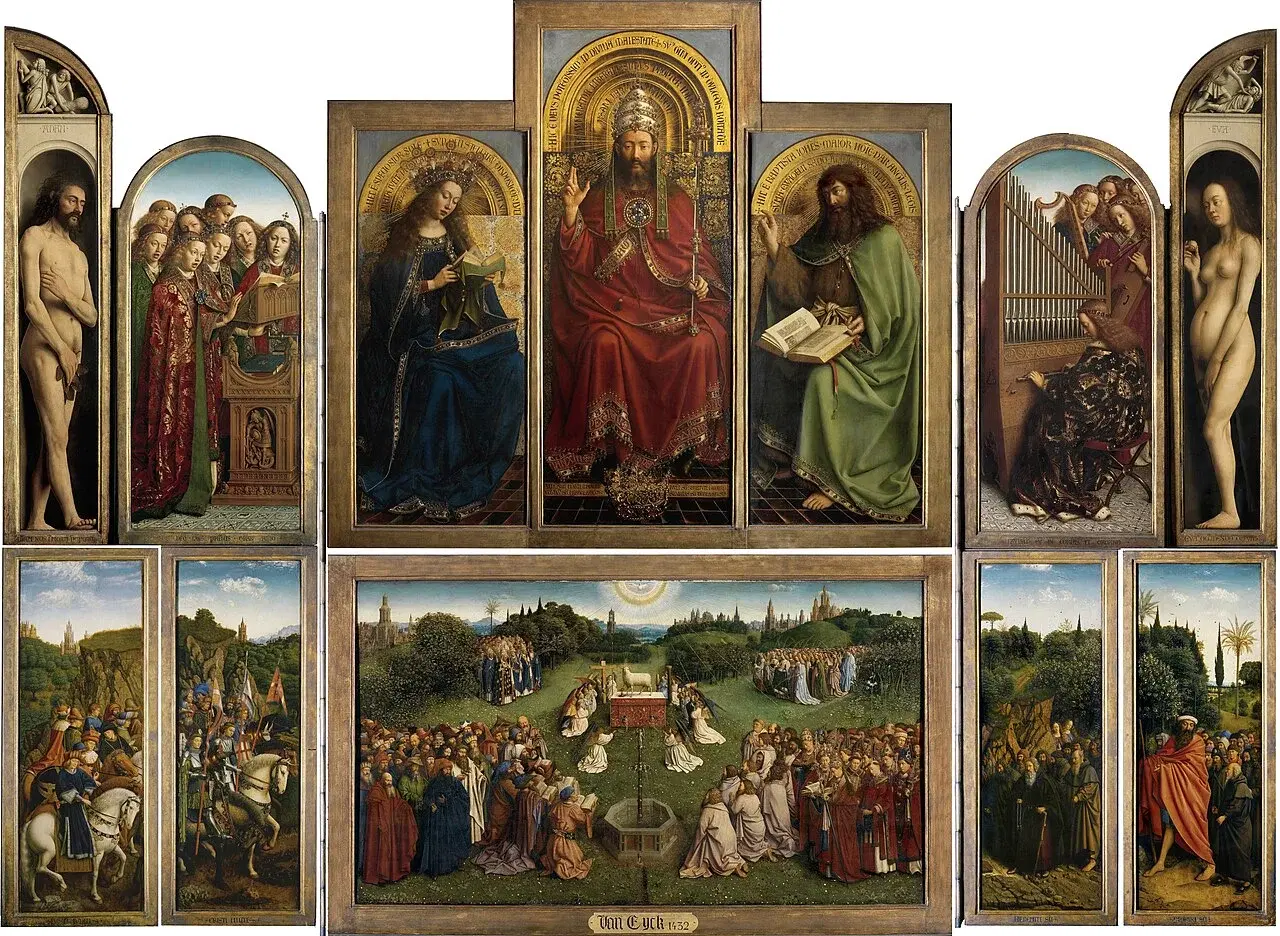
The Ghent Altarpiece, or 'Adoration of the Mystic Lamb,' is a monumental polyptych created in the 15th century by the brothers Hubert and Jan van Eyck for St. Bavo's Cathedral in Ghent, Belgium. This extraordinary work depicts a complex theological vision, with the upper register portraying the heavenly redemption featuring a central Deësis (God flanked by the Virgin Mary and John the Baptist), musical angels, and Adam and Eve. The lower register showcases a gathering of saints, sinners, clergy, and soldiers adoring the Lamb of God, overseen by the Holy Spirit. When closed, the altarpiece reveals grisaille paintings of St. John the Baptist and St. John the Evangelist, donor portraits of Joost Vijdt and Lysbette Borluut, and scenes of the Annunciation featuring the archangel Gabriel, culminating with prophets and sibyls at the top.
Beyond its intricate iconography, the Ghent Altarpiece holds immense historical significance as a pivotal work marking the transition from the Middle Ages to the Renaissance in European art. It's lauded as one of the earliest and most significant examples of oil painting, showcasing a move away from medieval idealization towards a meticulous observation of nature and human form. The question of attribution between the brothers Van Eyck continues to fascinate scholars, adding to the artwork's mystique and legacy. The intricate design is believed to have been initially conceived by Hubert, with Jan completing the majority of the painted panels.
The altarpiece's innovative style and technique are particularly noteworthy. Van Eyck demonstrated remarkable skill in rendering realistic textures, detailed clothing, and complex light effects. The use of oil paint and transparent glazes allowed for unprecedented subtlety and depth in depicting light and shadow, bringing the figures and landscapes to life. The inclusion of non-European vegetation and the careful attention to detail in the surrounding environment reflect a burgeoning interest in the natural world. Today, the Ghent Altarpiece remains a celebrated masterpiece, continuing to captivate audiences with its artistic brilliance and profound spiritual message.
How to experience it
use the interpretation tools to compare closed and open states
Don’t stop here
More to explore by Jan van Eyck
Same feeling, different artists