Golgotha
Meet the artist
EEdvard Munch1863–1944Norwegian
Dates
1900
Specifications
- Movement
- Expressionism, Symbolism
- Medium
- Oil Painting
- Genre
- Allegory, Religious Art
About the Artwork
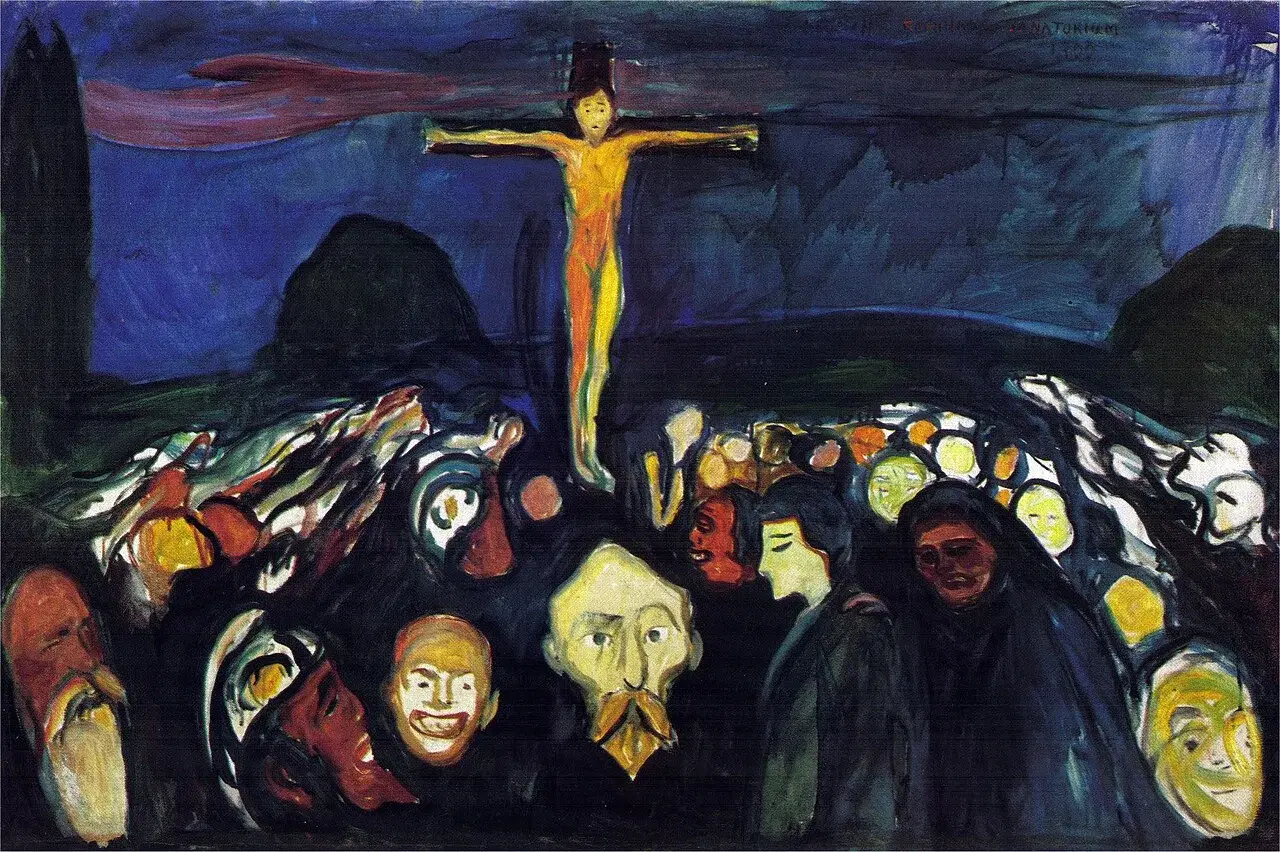
Painted in 1900, Golgotha represents Edvard Munch's deeply personal interpretation of the crucifixion, filtered through the psychological intensity that defines his entire body of work. Rather than a devotional image, the canvas is a raw exploration of suffering, crowd psychology, and spiritual isolation. The solitary crucified figure glows with an eerie, otherworldly light against a dark, turbulent sky, while below, a dense mass of distorted faces — rendered in lurid yellows, reds, and greens — press upward in an agitated, almost threatening throng. The faces are not those of mourners but of witnesses caught in a feverish human drama.\n\nMunch was raised in a strict pietistic household and wrestled with questions of faith, mortality, and existential anguish throughout his life. Golgotha, measuring 80 by 120 centimeters in oil on canvas, channels those preoccupations into a vision of Calvary that is less theological statement than an expressionist cry. The painting belongs to the Munch Museum in Oslo, which holds the world's largest collection of his work. It connects thematically to the broader Frieze of Life series through which Munch traced the full arc of human experience, from love and anxiety to death and the search for meaning.
Don’t stop here
More to explore by Edvard Munch
Same feeling, different artists