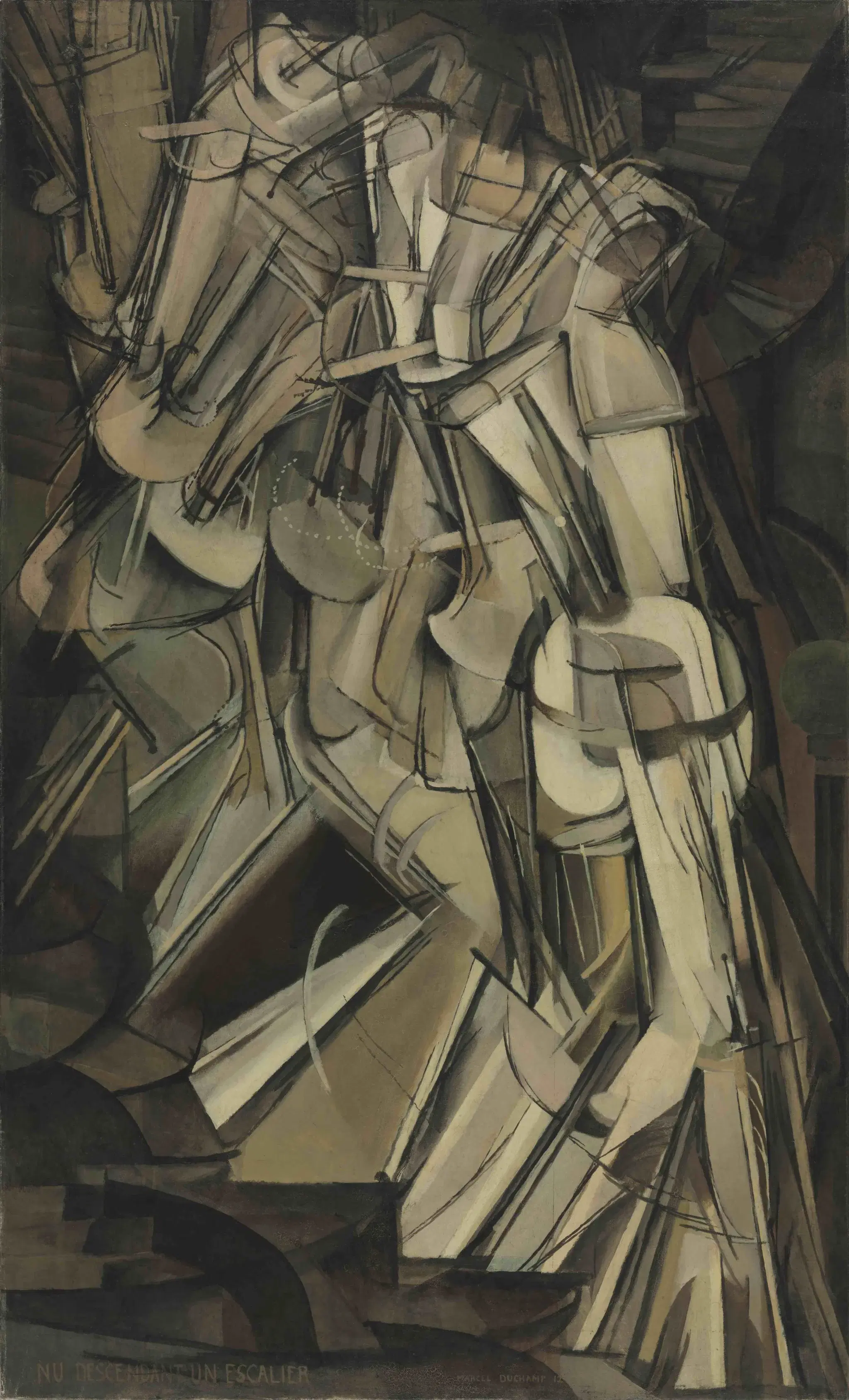
Nude Descending a Staircase, No. 2
#85
Meet the artist
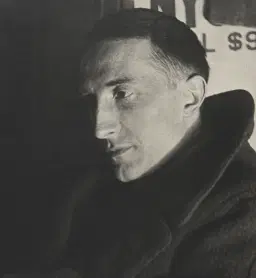
Marcel Duchamp1887–1968American, French
Dates
1912
Specifications
- Original title
- Nu descendant un escalier n° 2
- Dimensions
- 147 × 89.2 cm
Wikimedia Commons
About the Artwork
Marcel Duchamp's "Nude Descending a Staircase, No. 2" is a pivotal work of early Modernism that caused a sensation when it was exhibited at the 1913 Armory Show in New York City. Rather than depicting a traditional nude figure, Duchamp presents an abstract, fragmented figure in motion, rendered in shades of brown and beige. The composition suggests the sequential movement of a body walking down a staircase, breaking down form into geometric shapes and overlapping planes. This painting is more than just a representation; it's an exploration of time, motion, and the possibilities of capturing dynamism on a static canvas.
The painting's historical significance lies in its bold challenge to conventional artistic representation. It embodies the spirit of Cubism and Futurism, movements that sought to break away from traditional perspective and representational art. Duchamp blended these influences with his own unique approach, using mechanical and geometric forms to suggest human movement. The Armory Show, where this artwork was first exhibited in the United States, introduced European avant-garde art to a wider American audience, forever altering the landscape of art in the US and beyond. "Nude Descending a Staircase, No. 2" became a symbol of this revolutionary change and a lightning rod for debate about what constituted 'art'.
Duchamp's innovative artistic techniques involved using a muted palette and a combination of fragmented and overlapping forms to create a sense of continuous movement. The figure is deconstructed into a series of mechanical-looking shapes, suggesting a machine or automaton rather than a human being. This approach questioned traditional notions of beauty and challenged viewers to reconsider their expectations of art. By depicting motion as a series of static images, Duchamp foreshadowed the development of animation and film, demonstrating the power of art to explore new ways of perceiving reality. The painting's enduring relevance lies in its ability to provoke questions about the nature of representation, movement, and the boundaries of art itself.
How to experience it
read it as movement through time rather than a single body
Don’t stop here
More to explore by Marcel Duchamp
Same feeling, different artists