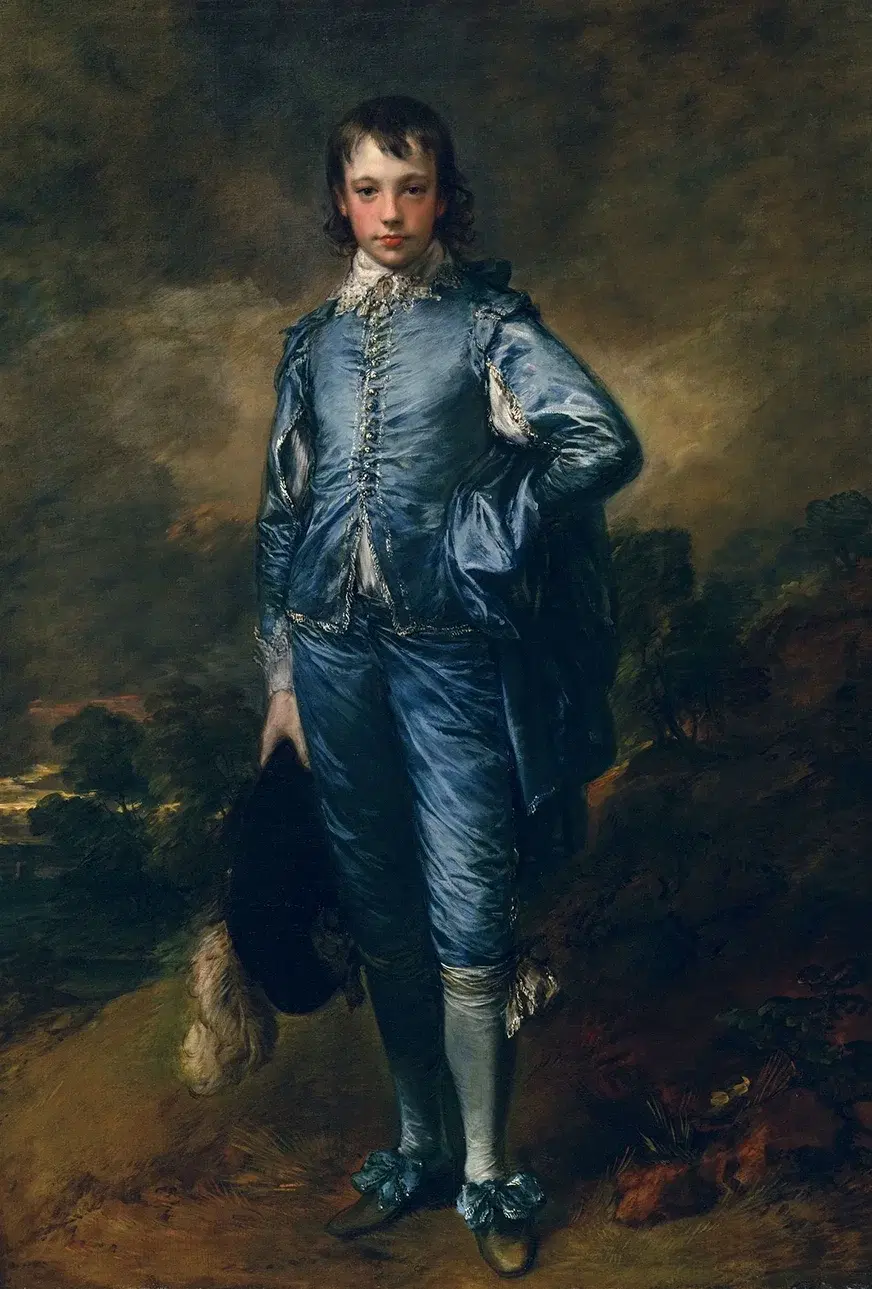
Thomas Gainsborough's The Blue Boy, painted around 1770, is one of the most iconic portraits in the history of British art. The nearly life-size figure of a young boy stands confidently against a stormy, atmospheric sky, dressed in an elaborate suit of shimmering blue satin that draws the eye immediately and irresistibly. Gainsborough's virtuoso handling of paint—layering ultramarine, smalt, Prussian blue, and possibly azurite in complex, vigorous strokes—gives the costume a luminous, almost liquid quality that seems to shimmer with the boy's self-assurance.\n\nThe painting is both a bravura portrait and a deliberate homage to Anthony van Dyck, whose seventeenth-century court costumes the boy's outfit evokes. First exhibited at the Royal Academy in 1770 under the title A Portrait of a Young Gentleman, it quickly became celebrated, and by the end of the century it had acquired its enduring nickname. The identity of the sitter remains debated: long believed to be Jonathan Buttall, son of a wealthy merchant, recent scholarship suggests the subject may be Gainsborough's own nephew, Gainsborough Dupont. In 1921, American collectors Henry and Arabella Huntington purchased the painting for $728,000—then the highest price ever paid for a painting—and brought it to California, where it now forms the centrepiece of the Huntington Art Museum in San Marino.
Join our community of art enthusiasts and discover exhibitions, artists, and masterpieces tailored to your tastes. Get personalized recommendations and never miss a must-see show again.