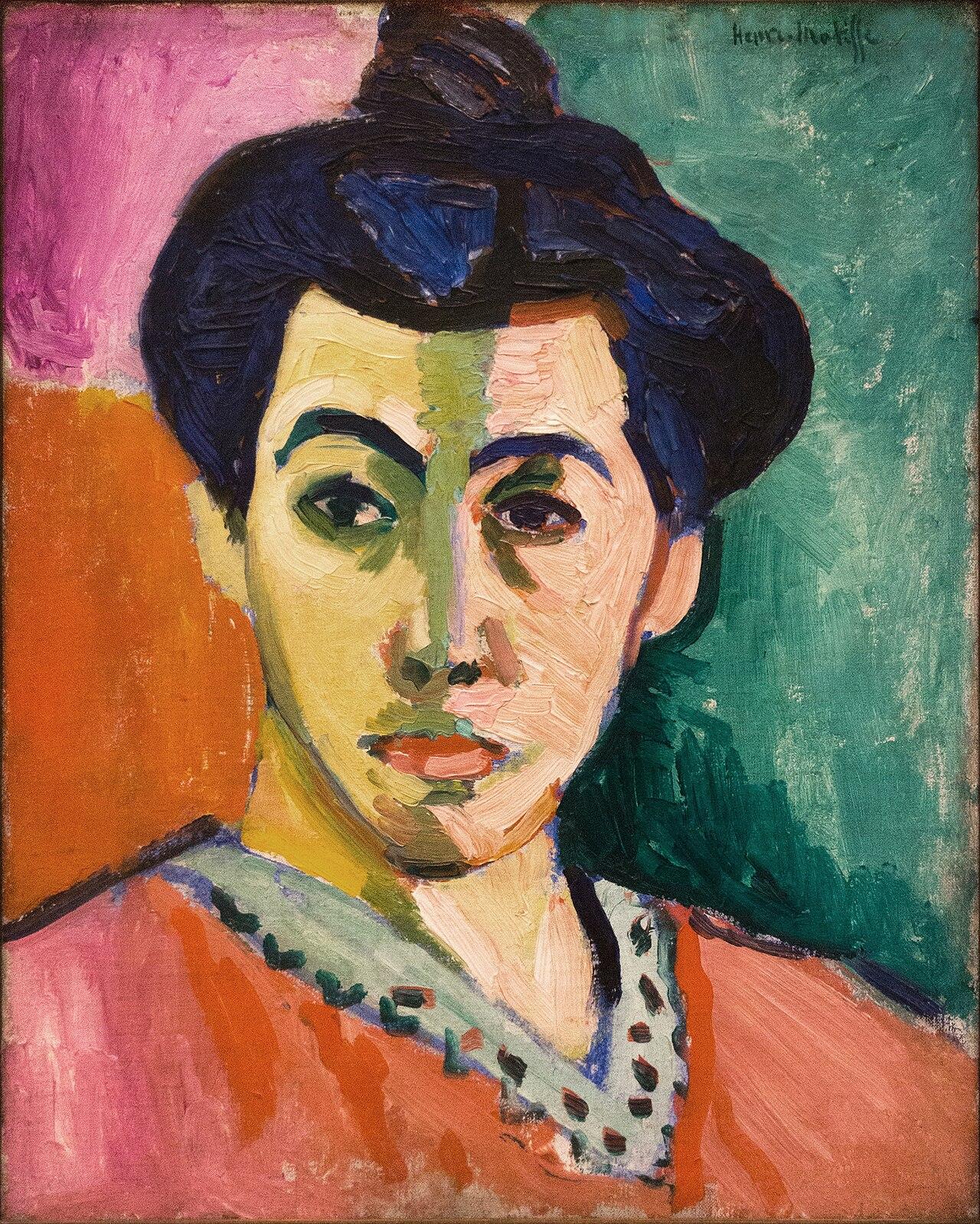
Madame Matisse
Meet the artist
Henri Matisse1869–1954French
Dates
1905
Specifications
- Movement
- Fauvism, Modernism
- Medium
- Oil Painting
- Genre
- Portrait
About the Artwork
Painted in the autumn of 1905 following a transformative summer in the fishing village of Collioure, Henri Matisse's portrait of his wife Amélie stands as one of the most audacious works in the history of modern portraiture. The painting — measuring just 40.5 by 32.5 centimeters — depicts the artist's wife in a formal, frontal pose, her face bisected by a bold vertical stripe of green paint running from her hairline to her upper lip. Rather than using shadow to model form in the traditional manner, Matisse assigned arbitrary, expressive color to each plane of the face, with warm oranges and pinks on one side and cool yellows on the other.\n\nThe green stripe itself serves as the dividing line between light and shadow, a solution so radical that it shocked audiences at the 1905 Salon d'Automne, where Matisse and his contemporaries were famously dubbed les Fauves — the wild beasts — by a scandalized critic. Yet the painting is not merely a provocation; it is a rigorously constructed composition in which color performs structural work with complete confidence. Part of the legendary Stein collection in Paris before making its way to Copenhagen, the work now resides at the Statens Museum for Kunst, where it remains one of the most studied examples of Fauvism's revolutionary approach to representation.
Don’t stop here
More to explore by Henri Matisse
Same feeling, different artists
Similar Works by Other Artists
Keep exploring