Parnassus
Meet the artist
Raphael1483–1520Italian
Dates
1509–1511
Specifications
- Movement
- High Renaissance
- Medium
- Fresco
- Genre
- Allegory, Mythological
About the Artwork
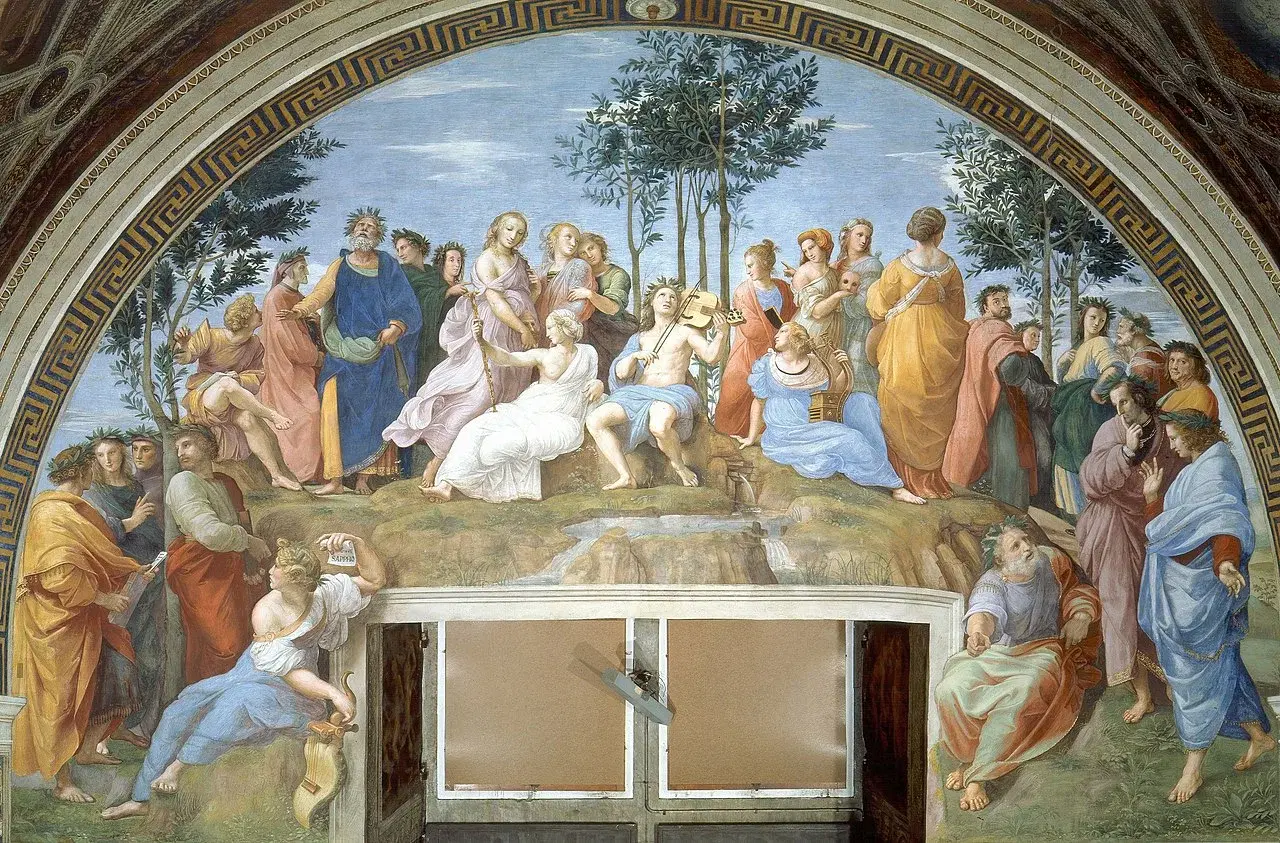
Raphael's Parnassus, painted between 1509 and 1511, occupies one of the four principal walls of the Stanza della Segnatura in the Vatican Palace — a room conceived as an intellectual temple celebrating the supreme domains of human knowledge. Where the adjacent School of Athens honors philosophy and the Disputa contemplates theology, the Parnassus is dedicated to poetry and the arts. At its center stands Apollo, playing a contemporary lira da braccio rather than an ancient lyre, surrounded by the nine Muses and an assembly of poets spanning antiquity to Raphael's own time: Homer, Virgil, Horace, Ovid, Dante, Petrarch, and Boccaccio appear together in a single timeless gathering.\n\nThe fresco, measuring approximately 670 cm at its base, is shaped to accommodate a real window below it — a window that opens onto the actual Vatican hill, thought in antiquity to be sacred to Apollo, making the illusion between painted and real landscape remarkably layered. Commissioned by Pope Julius II as part of a grand decorative program for his personal apartments, the work exemplifies the High Renaissance ideal of synthesizing classical learning with Christian humanism. The graceful figures, idealized landscape, and harmonious spatial composition demonstrate Raphael at the height of his powers.
Don’t stop here
More to explore by Raphael
Same feeling, different artists