Sistine Madonna
#73
Meet the artist

Raphael1483–1520Italian
Dates
1512–1513
Specifications
- Original title
- Sixtinische Madonna
- Dimensions
- 265 × 196 cm
Wikimedia Commons
About the Artwork
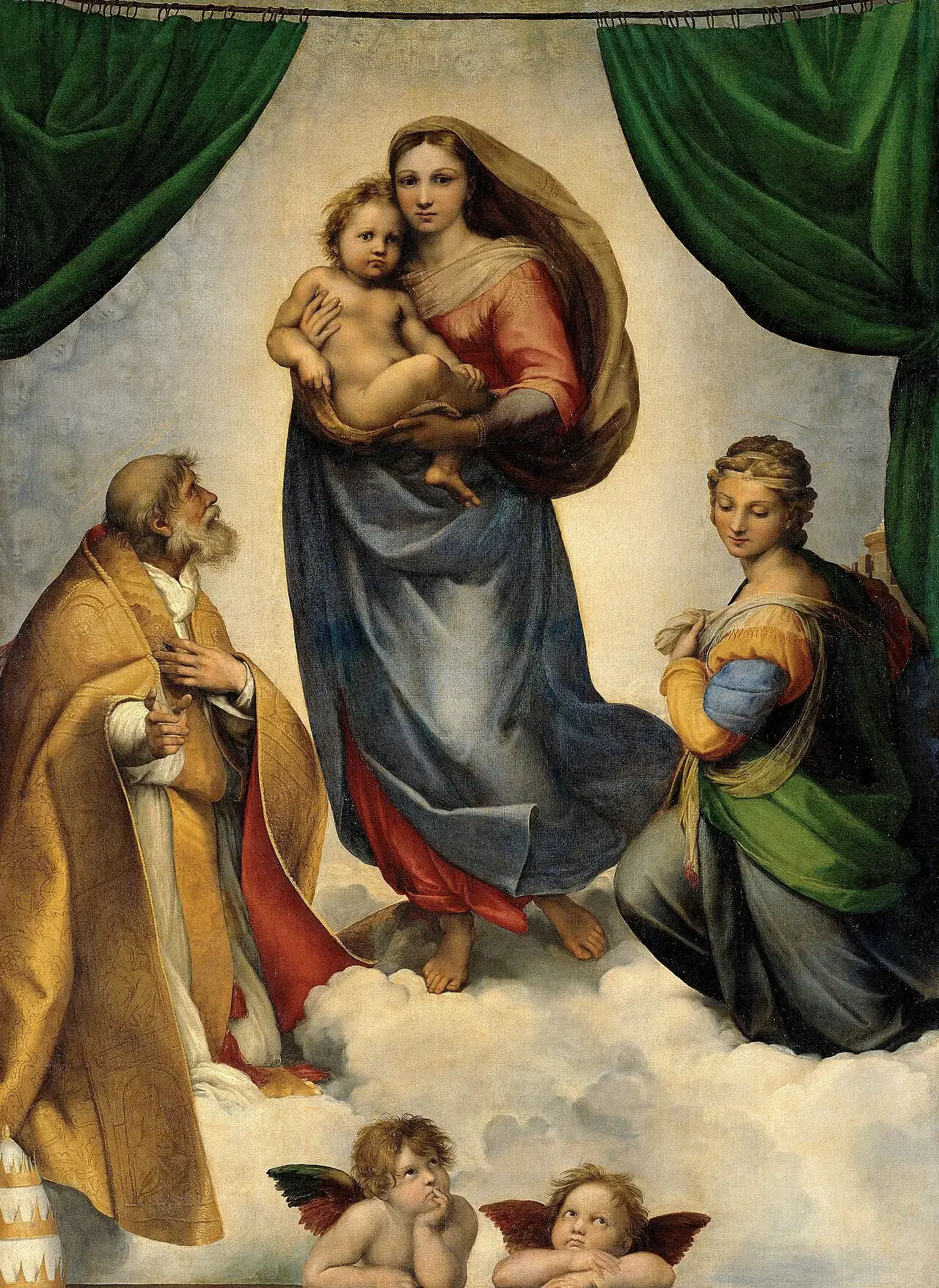
Raphael's "Sistine Madonna," also known as the "Madonna di San Sisto," is a masterpiece of the High Renaissance, completed around 1513-1514. Commissioned by Pope Julius II for the church of San Sisto in Piacenza, it depicts the Virgin Mary holding the Christ Child, flanked by Saint Sixtus and Saint Barbara. Mary appears to descend from the heavens, standing on clouds before a multitude of obscured putti, while two distinctive winged putti rest below. This altarpiece not only showcases Raphael's mastery of composition and idealized beauty but also served as a powerful symbol for the commissioning Pope. Giorgio Vasari recognized its greatness centuries ago, deeming it a "truly rare and extraordinary work," a sentiment echoed by countless viewers since.
The historical significance of the "Sistine Madonna" extends beyond its initial religious purpose. Acquired by Augustus III of Poland in 1754 and relocated to Dresden, the painting achieved iconic status in Germany. It ignited debates about art, religion, and national identity, inspiring Romantic artists, writers, and philosophers like Goethe, Wagner, Nietzsche, and Dostoyevsky. The painting has even had a tumultuous history involving its rescue from the bombing of Dresden during World War II and subsequent relocation to Moscow before being returned to Germany. Its enduring influence is visible in later works of art that directly reference it, such as the Soviet-era paintings Partisan Madonna of Minsk and And the Saved World Remembers.
Raphael's artistic techniques are evident in the "Sistine Madonna." Pigment analysis reveals the use of traditional Renaissance materials, including natural ultramarine, malachite, orpiment, lead-tin-yellow, vermilion, and lead white. The blending of these pigments creates a harmonious and luminous effect, particularly in the Madonna's blue robe and the details of Saint Barbara's sleeve. The artwork's enduring appeal lies not only in its technical skill but also in its profound emotional resonance. The Madonna's gaze, the tenderness of the Christ Child, and the watchful presence of the saints combine to create a powerful image of divine grace and human connection. The two putti at the bottom have gained particular fame of their own, and are a well known artistic motif worldwide.
How to experience it
look beyond the cherubs to the theatrical curtain reveal
Don’t stop here
More to explore by Raphael
Same feeling, different artists