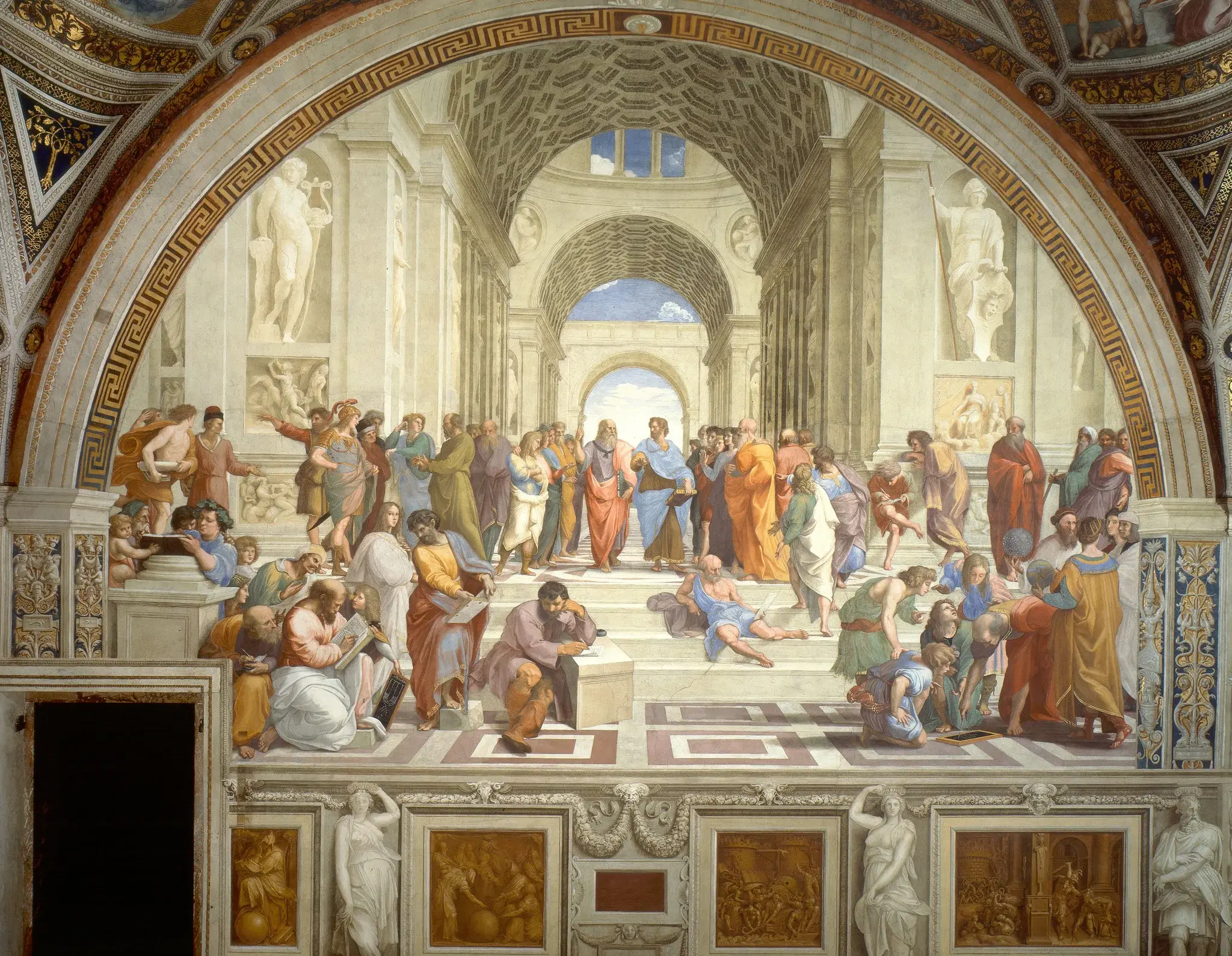
The School of Athens
#10
All the greatest minds in history… in one perfect room.
Meet the artist
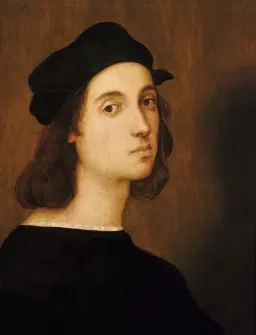
Raphael1483–1520Italian
Dates
1509–1511
Specifications
- Original title
- Scuola di Atene
- Movement
- High Renaissance
- Medium
- Fresco
- Genre
- Allegory
- Dimensions
- 500 × 770 cm
Wikimedia Commons
About the Artwork
A grand architectural space opens before you — inspired by classical Rome, but imagined as something even more perfect.
At the center, two figures walk toward you: Plato pointing upward, and Aristotle gesturing toward the earth.
Around them, dozens of philosophers, mathematicians, and thinkers gather in animated groups — debating, writing, teaching, thinking.
It’s not chaos. It’s harmony in motion.
Raphael's "The School of Athens," painted between 1509 and 1511, is a monumental fresco that embodies the spirit of the Italian Renaissance. Commissioned by Pope Julius II for the Vatican's Stanza della Segnatura, it depicts a gathering of ancient Greek philosophers, mathematicians, and scientists, creating a visual representation of philosophy as a branch of knowledge. The work serves as a powerful allegory for the rebirth of classical learning in Europe, reflecting the era's fascination with ancient wisdom and the pursuit of knowledge.
Beyond its subject matter, "The School of Athens" is celebrated for its masterful use of perspective, a defining characteristic of Renaissance art. Raphael expertly employs linear perspective to create a sense of depth and realism, drawing the viewer into the scene. The fresco's composition is carefully arranged, with figures interacting in dynamic poses and engaging in thoughtful dialogue. Furthermore, the inclusion of portraits of Renaissance artists like Leonardo da Vinci (as Plato) and Michelangelo (as Heraclitus) alongside ancient thinkers underscores the connection between classical and contemporary intellectual achievement. It showcases the techniques used by Leonardo and others during the Italian Renaissance.
"The School of Athens" remains significant because it encapsulates the Renaissance ideal of humanism, celebrating human intellect and the pursuit of knowledge. It demonstrates the importance of Philosophy, poetry, theology and justice, and encourages viewers to question all knowledge. Its enduring appeal lies in its ability to convey the timelessness of philosophical inquiry and the power of intellectual exchange. By harmonizing classical ideals with Renaissance artistic innovation, Raphael created a masterpiece that continues to inspire and captivate audiences today, serving as a testament to the enduring legacy of ancient Greek thought and the brilliance of the Renaissance era.
Spotlight
Raphael creates the ultimate intellectual universe:
Every figure represents a great mind — from Socrates to Pythagoras
Many faces are actually portraits of Renaissance artists — including Leonardo da Vinci as Plato and Michelangelo as Heraclitus
Raphael even paints himself into the scene, quietly looking out
And then there’s the deeper idea:
This isn’t just about ancient Greece — it’s about the Renaissance belief that knowledge, art, and humanity are all connected.
Worth the trip
Because standing inside the room at the Apostolic Palace is like stepping into the mind of civilization itself. You’re surrounded — not just by beauty — but by ideas. It’s immersive, intellectual, and surprisingly emotional. If Artlovers is about traveling for inspiration, this is one of the clearest origins of that feeling: the moment humanity painted its own intelligence as something worth celebrating.
How to experience it
Don’t look straight up. - Let the space open first — it’s immersive.
Find the center immediately - Plato (pointing up) and Aristotle (pointing forward) are your anchor.
Follow the groups - Each cluster is a conversation. Move from one to another like scenes.
Look for familiar faces - Leonardo da Vinci, Michelangelo… even Raphael himself is inside.
Step closer, then back again - Details vs. harmony. You need both.
Let it feel alive - It’s not a static fresco — it’s a room full of ideas in motion.
Artlovers tip
Don’t try to recognize everyone. Just ask yourself: which group would I join?
Don’t stop here
More to explore by Raphael
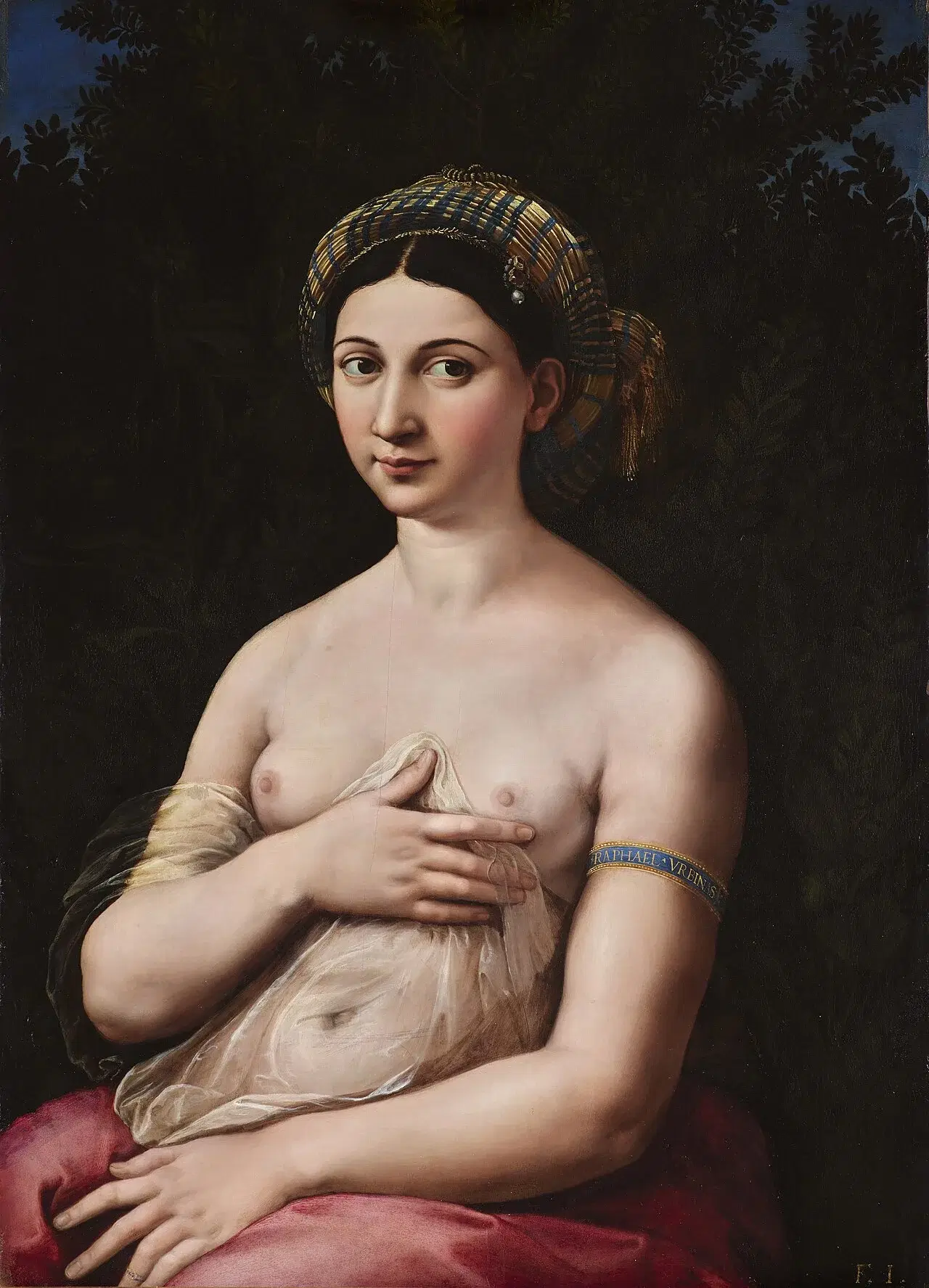
Same feeling, different artists