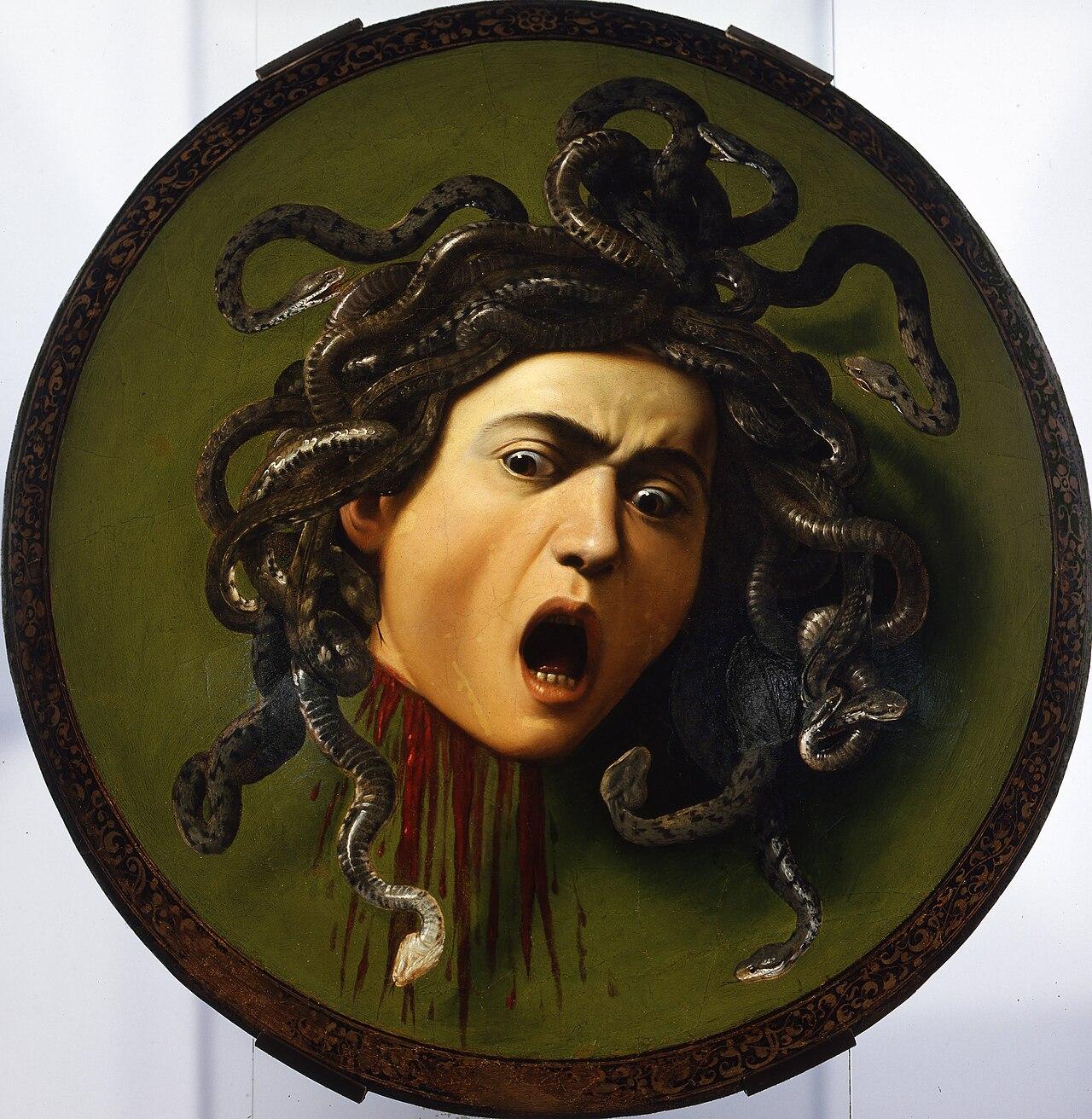
Medusa
Meet the artist
CCaravaggio1571–1610Italian
Dates
1597–1598
Specifications
- Movement
- Baroque
- Medium
- Oil Painting
- Genre
- Mythological
About the Artwork
Caravaggio's Medusa is among the most technically inventive and psychologically arresting works of the Italian Baroque. Painted around 1597 on a convex canvas mounted onto a wooden ceremonial shield, the work was commissioned by Cardinal Francesco Maria del Monte as a diplomatic gift for Grand Duke Ferdinando I de' Medici of Tuscany. Caravaggio chose to depict the precise moment of Medusa's decapitation by Perseus — the severed head still alive with horror, mouth open in a scream, eyes wide with the shock of its own death, snakes writhing from the neck like living brushstrokes.\n\nIn a bold act of self-identification, Caravaggio used his own likeness as the model for the Gorgon's face, simultaneously presenting himself as the monster and as the hero who overcomes her. The convex surface of the shield amplifies the illusion of three-dimensionality, making the head appear to project outward toward the viewer. This mastery of illusionism in service of psychological impact exemplifies the chiaroscuro technique for which Caravaggio became famous — dramatic contrasts of light and darkness that render flesh with startling realism while heightening emotional tension. The work has been housed in the Uffizi Gallery in Florence since the seventeenth century, where it remains one of the collection's most mesmerizing treasures.
Don’t stop here
More to explore by Caravaggio
Same feeling, different artists